Can you run central air on a generator?
Yes, you can run central air on a generator — but the running wattage isn’t what stops most generators cold. It’s the startup surge. A standard 3-ton central AC unit draws about 3,500 watts while running but spikes to 10,000 to 12,000 watts for a fraction of a second when the compressor kicks on. Understanding starting watts vs running watts is the whole game here. Get a soft starter installed, and the math changes completely.
Why the startup surge is the real problem
Central AC compressors contain large induction motors. When power hits that motor at startup, the rotor hasn’t begun spinning yet. For a brief moment — sometimes less than half a second — the motor draws an enormous amount of current to overcome inertia and get the compressor spinning up to speed. This is called Locked Rotor Amps, or LRA.
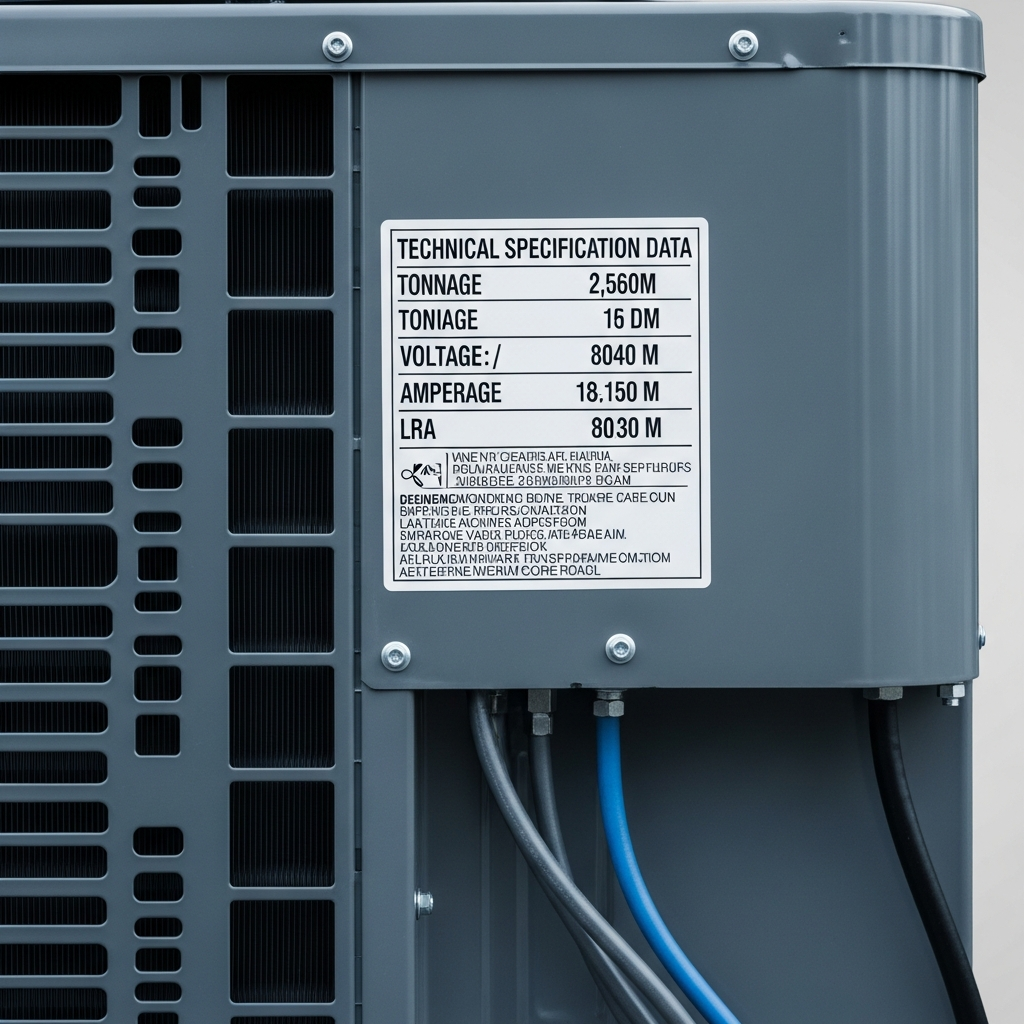
LRA is printed right on the compressor nameplate, alongside the Full Load Amps (FLA) figure that represents normal running draw. The ratio between them tells you how violent the startup surge will be.
For a 3-ton central AC compressor, LRA is typically 80 to 120 amps at 240 volts. Run the math: 100 amps × 240 volts = 24,000 watts, briefly, at the moment of startup. That number comes down fast as the motor accelerates, but the damage is already done to an undersized generator before it does.
What “tonnage” means in watts
AC capacity in tons is a legacy measure of refrigeration — one ton equals 12,000 BTU per hour. As a rough conversion for generator sizing, 1 ton of AC capacity translates to about 1,200 watts of running load. Here’s how that plays out:
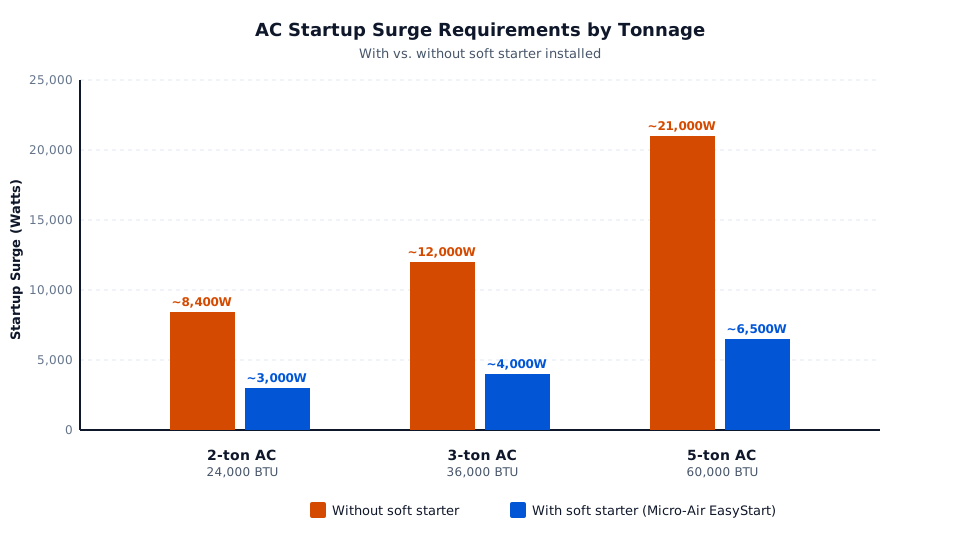
2-ton central AC (24,000 BTU):
- Running draw: ~2,400 watts
- Startup surge without soft starter: 7,200 to 9,600 watts
- Startup surge with soft starter: 2,400 to 3,500 watts
3-ton central AC (36,000 BTU):
- Running draw: ~3,500 watts
- Startup surge without soft starter: 10,500 to 14,000 watts
- Startup surge with soft starter: 3,500 to 4,500 watts
5-ton central AC (60,000 BTU):
- Running draw: ~6,000 watts
- Startup surge without soft starter: 18,000 to 24,000 watts
- Startup surge with soft starter: 5,500 to 7,500 watts
Most portable generators are rated for surge capacity at 1.5 to 2 times their continuous wattage. A 7,500-watt generator might handle a 10,000-watt surge. That’s not enough for a 3-ton AC cold-starting without assistance. Not even close.
Why generators fail when central AC starts
Generators don’t just measure power — they maintain frequency and voltage. When a large inductive load starts, it drags on the generator’s alternator. If the electrical demand exceeds what the engine can sustain even momentarily, one of three things happens: the voltage collapses (the lights dim and everything slows down), the generator’s overload protection trips, or the engine bogs down and stalls.
Generator manufacturers list surge ratings, but those ratings assume the overload is brief and the generator recovers. A central AC compressor starting without a soft starter draws full LRA for long enough that many generators can’t hold on. The compressor motor may even fail to start — it just hums and draws locked-rotor current until the thermal overload in the compressor trips.
This is not a situation you want to stress-test in August with your generator already hot.
The soft starter solution
A soft starter solves the problem by controlling how voltage is applied to the compressor motor at startup. Instead of hitting the motor with full line voltage the instant the contactor closes, the soft starter ramps voltage up over 1 to 3 seconds, letting the rotor accelerate gradually. The LRA spike is dramatically reduced.
The Micro-Air EasyStart is the most widely installed unit for residential AC compressors. It wires between the contactor and the compressor terminals, costs around $300 to $400 depending on the compressor size, and reduces starting current by 60 to 75 percent.
What that means in practice: a 3-ton AC that normally surges to 10,000 to 12,000 watts at startup surges to roughly 3,500 to 4,500 watts with an EasyStart. A 7,500-watt generator that couldn’t touch a 3-ton AC can now start it — comfortably.
Installation is a 1- to 2-hour job for a qualified HVAC technician. The EasyStart is compatible with most single-stage and two-stage compressors made in the last 30 years. Scroll compressors, piston compressors — it handles both. Variable-speed inverter compressors are a different story, covered below.
Sizing your generator correctly
Once you have a soft starter in the equation, the sizing math becomes manageable. The formula is:
Total running watts + largest single surge = minimum generator surge rating
A worked example for a house with a 3-ton AC and typical background loads:
- 3-ton AC running: 3,500 watts
- Refrigerator running: 200 watts
- Lighting, phone chargers, misc: 500 watts
- Internet router and modem: 50 watts
- Total running load: 4,250 watts
- Largest single surge (soft-started 3-ton AC): 4,500 watts
- Required generator surge capacity: 8,750 watts
A 10,000-watt generator (with a 12,500-watt surge rating) covers this setup with margin to spare. Use our home generator sizing calculator to run these numbers for your specific equipment.
Without the soft starter, that same setup demands a generator capable of surging to at least 14,000 to 16,000 watts, which means a 12,000- to 15,000-watt commercial generator. The cost difference is significant: a 10,000-watt generator runs $1,200 to $2,000 versus $3,000 to $5,000 for a 15,000-watt unit. The $350 soft starter pays for itself before you leave the parking lot.
Heat pumps and variable-speed systems: a different problem
Heat pumps run on similar principles — refrigerant cycle, compressor, condenser — but the situation splits depending on what type you have.
Single-stage heat pumps with fixed-speed compressors can accept a soft starter. Same solution, same math. The EasyStart works on most of them.
Variable-speed inverter heat pumps (mini-splits, modern high-efficiency ducted systems) are different. Their compressors are driven by a variable-frequency drive that already controls motor speed. They ramp up gradually by design. The startup surge is much lower — often 2 to 3 times the running draw, not 4 to 6 times. You may not need a soft starter at all. Check the spec sheet for LRA.
The tricky part with variable-speed inverter systems is generator compatibility. Some inverter drives are sensitive to generator output quality. Cheap generators with poor voltage regulation can cause inverter faults. Inverter generators — Honda EU series, Yamaha EF series — produce cleaner power and pair better with variable-speed loads.
The honest assessment: is it actually worth it?
Running central AC on a generator is technically achievable. Whether it’s worth the cost and complexity is a different question.
Here’s what you’re looking at for a typical 3-ton central AC:
- Generator capable of the load: $1,500 to $2,500 (10,000-watt unit)
- Soft starter (EasyStart or equivalent): $300 to $400 installed
- Transfer switch or interlock kit: $200 to $800
- Total system cost for AC backup: $2,000 to $3,700
And then there’s fuel. A 10,000-watt propane generator running at 50 percent load to power central AC consumes roughly 0.8 to 1.2 gallons of propane per hour. Over a 72-hour outage, that’s 58 to 86 gallons of propane — $150 to $220 just in fuel, assuming you can find propane during a regional emergency.
A window unit for a single bedroom draws 500 to 1,200 watts. A 3,500-watt generator runs one easily, has fuel to spare for the refrigerator and a few lights, costs $400 to $700 total, and burns 0.3 gallons of gas per hour. For most people evaluating which essential appliances to power during an outage, concentrated cooling in one room is a smarter, cheaper answer than trying to maintain whole-home comfort.
The central AC solution makes sense in specific situations: elderly or medically vulnerable household members who can’t tolerate heat in any room, extreme heat climates where even one room becomes unsafe, or homes already investing in a large standby generator for other reasons.
If you’re buying a generator specifically to run central AC, pause and price out the window unit alternative first.
Finding the LRA for your AC unit
Before you buy anything, find the actual LRA for your specific compressor. Here’s how:
- Go to the outdoor condenser unit. Look for the data plate on the side panel — it’s usually a silver or white label riveted to the metal housing.
- Find the line labeled “LRA” (sometimes listed as “RLA” for Rated Load Amps and “LRA” for locked rotor — you want LRA).
- Multiply LRA by the supply voltage (almost always 240V for central AC) to get starting watts.
- Compare that number to your generator’s surge rating.
If the label is gone or illegible, search the model number from the data plate along with “LRA spec sheet.” Manufacturers like Carrier, Trane, Lennox, and Rheem all publish this data. HVAC supply houses can usually look it up in 30 seconds.
Summary
Central AC and generators can work together, but only with the right hardware. Without a soft starter, most portable generators — even large ones — will fail to start a 2-ton or larger AC compressor. With a Micro-Air EasyStart installed, a 7,500 to 10,000-watt generator can handle a 3-ton system.
The startup surge, not the running load, is what you’re solving for. LRA times voltage gives you the number. Get that number before you buy anything.
Running central AC on a generator is possible, but expensive and complicated. Before committing to a generator big enough to handle it, do the full load calculation on your house: home generator sizing calculator.