Home generator sizing calculator
Here’s how to size a generator for your house: walk every room, read the nameplate on every appliance you care about, write down volts and amps, multiply them together, and add up the results. That’s it. You don’t need a fancy online calculator. You need a notepad and 45 minutes.
The reason most people get this wrong isn’t because the math is hard. It’s because they skip the load audit and just guess. Someone tells them a 7,500-watt generator is “enough for most houses,” they buy it, and then they plug in the well pump during a storm and watch the generator stall. The math would have told them exactly what was coming.
Reading the nameplate: volts times amps equals watts
Every appliance has a label on it somewhere — usually a metal tag on the back, a sticker on the bottom, or a plate near the power cord. It lists voltage, amperage, and sometimes wattage directly. The formula is:
Volts x Amps = Watts
A refrigerator rated 120V and 6A draws 720 watts running. A window AC rated 120V and 12A draws 1,440 watts. A sump pump rated 120V and 9A draws 1,080 watts. That’s all the math you need.
If the nameplate lists watts directly, use that number. Some appliances list wattage (microwave ovens usually do), some list only amps (most motors), and some list both. If it lists kW instead of W, multiply by 1,000 to get watts. A water heater rated 4.5 kW draws 4,500 watts.
One thing to get right: most 240-volt appliances list amps at 240V, not 120V. Your electric dryer might say 240V / 30A, which means 7,200 watts. Don’t accidentally calculate it at 120V and get a number that’s half wrong.
Starting watts: the number that actually matters for motors
Running watts are what an appliance draws once it’s up and speed. Starting watts are what it pulls for 1-3 seconds to spin a motor up from zero. For anything with a compressor or pump motor, the starting draw is 2 to 3 times the running draw.
That sump pump drawing 1,080 watts running? It pulls 2,700 to 3,240 watts at startup. Your 3-ton central AC unit running at 3,500 watts? It can hit 8,000 to 11,000 watts at startup.
Your generator needs to handle the highest starting surge you’ll ever produce, not just the total running load. If you’re running the AC, the refrigerator, and the sump pump simultaneously and the sump pump kicks on, that startup surge is what will trip your generator’s overload or stall the engine.
The practical rule: treat motors as running load for your “can I run everything simultaneously” math, but size your generator’s surge capacity (its “peak watts” spec) to handle your single largest motor starting while everything else is already running. There’s a longer breakdown of how this math works in our guide to starting watts vs running watts.
Critical loads vs. convenience loads
Before you start adding up wattages, sort your list into two buckets.
Critical loads are things that affect health, safety, or major property damage if they lose power. For most houses this means:
- Refrigerator and chest freezer (food safety)
- Sump pump (flood prevention)
- Well pump (water supply)
- Furnace blower motor (heat in winter)
- Medical equipment (CPAP, oxygen concentrator, home dialysis)
- A few lights
Convenience loads are everything else. Dishwasher, clothes dryer, EV charger, hot tub, garbage disposal, window AC units beyond the bedroom. Nice to have, but your house isn’t in danger if they’re off for 12 hours.
This distinction matters because it determines how large a generator you actually need. If you only care about critical loads, a 5,500-watt portable generator handles most houses. If you want to run the central AC and live relatively normally, you’re looking at 10,000-watt territory. If you want full-house coverage, you need a standby generator in the 20,000+ watt range.
Building your room-by-room power audit
Walk the house. Open every cabinet, look under sinks, check every room. You’re looking for anything that draws power and matters to you during an outage. Make a table. It looks like this:
| Appliance | Volts | Amps | Running Watts | Starting Watts | Priority |
|---|---|---|---|---|---|
| Refrigerator | 120 | 6 | 720 | 1,440 | Critical |
| Chest freezer | 120 | 5 | 600 | 1,200 | Critical |
| Sump pump (1/2 hp) | 120 | 9 | 1,080 | 2,700 | Critical |
| Well pump (1/2 hp) | 240 | 7 | 1,680 | 4,200 | Critical |
| Furnace blower | 120 | 8 | 960 | 1,920 | Critical |
| Bedroom window AC | 120 | 12 | 1,440 | 3,600 | Comfort |
| Microwave | 120 | 10 | 1,200 | 1,200 | Comfort |
| Lights (LED, 10 circuits) | 120 | — | 400 | 400 | Critical |
| Phone/laptop charging | 120 | — | 150 | 150 | Critical |
That’s not an exhaustive list — it’s an example of what the worksheet looks like. Your list will be different based on what appliances you have and how your house is heated.
Do the audit in person. Don’t go from memory. I’ve talked to people who forgot they had a chest freezer in the garage, forgot the irrigation controller draws power, forgot about the sump pit they didn’t know existed until they moved a shelf. The nameplate on the actual appliance is the only reliable source.
The three-tier approach: survival, comfort, full house
Once you have your load list, run the numbers at three levels. This gives you a cleaner decision framework than trying to hit one exact wattage.
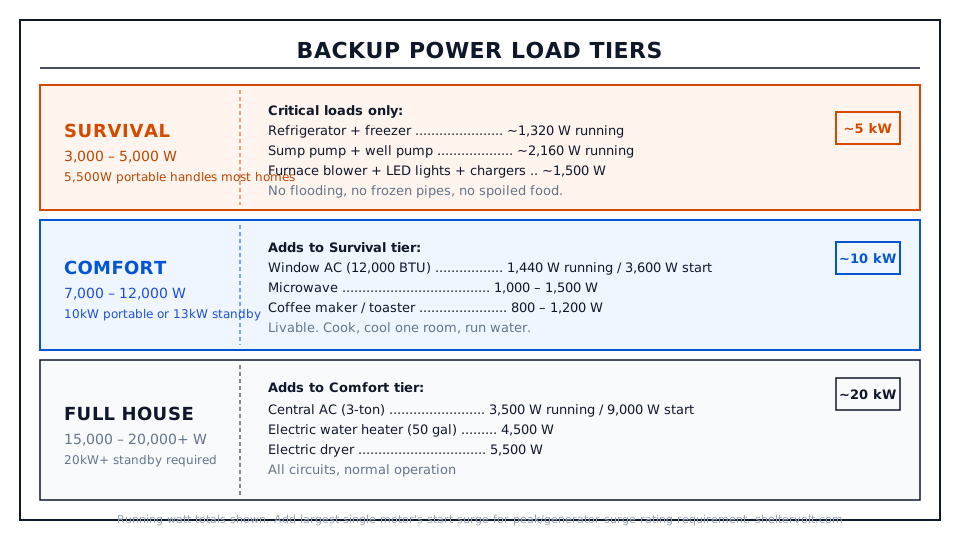
Survival (~3,000 to 5,000 watts): Refrigerator, freezer, sump pump, furnace blower, lights, phone charging. The house is livable. Nothing floods, nothing spoils, no one freezes. A 5,500-watt portable generator handles this tier for most houses.
Comfort (~7,000 to 12,000 watts): Everything above plus a window AC or two, the microwave, the coffee maker, limited well pump use. You can cook, sleep comfortably, and run water. A 10,000-watt portable or a 13kW standby covers this range.
Full house (~15,000 to 20,000+ watts): Central AC, electric water heater, all lighting, all appliances. Life continues roughly normally. This requires a permanent standby generator, usually a 20kW or 22kW unit connected via a whole-house transfer switch.
Most households doing 8 to 12 hours of outage coverage don’t actually need the full-house tier. Survival plus comfort gets you through 99% of real outages without freezing or losing food.
Worked example: 2,000 sq ft house, mixed loads
Let’s make this concrete. The house:
- 2,000 square feet
- Gas forced-air heat (electric blower motor)
- Electric water heater (50 gallon, 4,500W element)
- 3-ton central AC (typical 3,500W running, 9,000W start)
- Refrigerator (720W running, 1,440W start)
- 1/2 hp well pump (1,680W running, 4,200W start)
- 1/3 hp sump pump (480W running, 1,440W start)
- LED lighting throughout (250W total)
- Misc small loads: phone charging, modem, TV (300W)
Survival tier load (running): Furnace blower (960W) + refrigerator (720W) + sump pump (480W) + well pump (1,680W) + lighting (250W) + small loads (300W) = 4,390W running
Largest starting surge: well pump at 4,200W start, while everything else is already running. Total surge: 4,390W + (4,200 - 1,680)W = 4,390 + 2,520 = 6,910W peak.
That means survival tier requires a generator rated at least 6,910W peak (surge), which points to a 7,500W portable or larger. A 5,500W generator won’t start the well pump reliably with everything else already running.
Comfort tier (add window AC and microwave to survival): 4,390W + 1,440W (window AC) + 1,200W (microwave, not simultaneous) = 5,830W running. With the AC’s 3,600W start: 5,830 + (3,600 - 1,440) = 7,990W peak. A 10,000W portable handles this with headroom.
Full-house tier (add central AC, electric water heater): Running: 4,390W + 3,500W (central AC) + 4,500W (water heater) = 12,390W running. Central AC start with everything running: 12,390 + (9,000 - 3,500) = 17,890W peak. You’re in 18-20kW standby generator territory.
Reality check on EIA data: The average U.S. home uses about 30 kWh per day. That sounds like a lot, but most of it comes from always-on loads and overnight usage. During a 12-hour outage where you’re running selectively, a well-managed comfort-tier setup uses 8 to 12 kWh. A 10,000W generator running 50% of the time over 12 hours produces 60 kWh of capacity — far more than you need. The sizing question is about peak surge capacity, not total energy throughput.
The one mistake that derails every sizing calculation
People calculate running watts, buy a generator rated for that number, and discover on day one that it won’t start their motors. Running watts and surge watts are different numbers. Every generator has a “running” rating and a “peak” or “surge” rating. The peak rating is typically 10-25% higher and is only sustained for a few seconds. When a product lists “10,000W generator,” check whether that’s continuous or peak. Most portable generators rate their peak, not their continuous output. The continuous rating is usually 10-15% lower.
When you’re buying, confirm the continuous watt rating. That’s what determines whether the generator can actually run your loads, not the big number on the box.
The other common miss: forgetting that some loads are never simultaneous. You don’t run the microwave and the toaster and the hair dryer at the same time. You don’t run the electric dryer and the water heater at the same time. Real load audits account for maximum simultaneous usage, not the sum of every appliance in the house.
Your load list is the generator spec
Once you’ve done the room-by-room audit and run the numbers at each tier, you have the actual spec for what you need. Take that list to a generator purchase, not a “square footage of house” guess.
When a salesperson asks “how big is your house,” give them your load list instead. If they can’t work with it, find someone who can.
Once you have your load list, the next concept that trips people up is starting surge. Here’s how to account for it: starting watts vs running watts.