Essential appliances to power during an outage
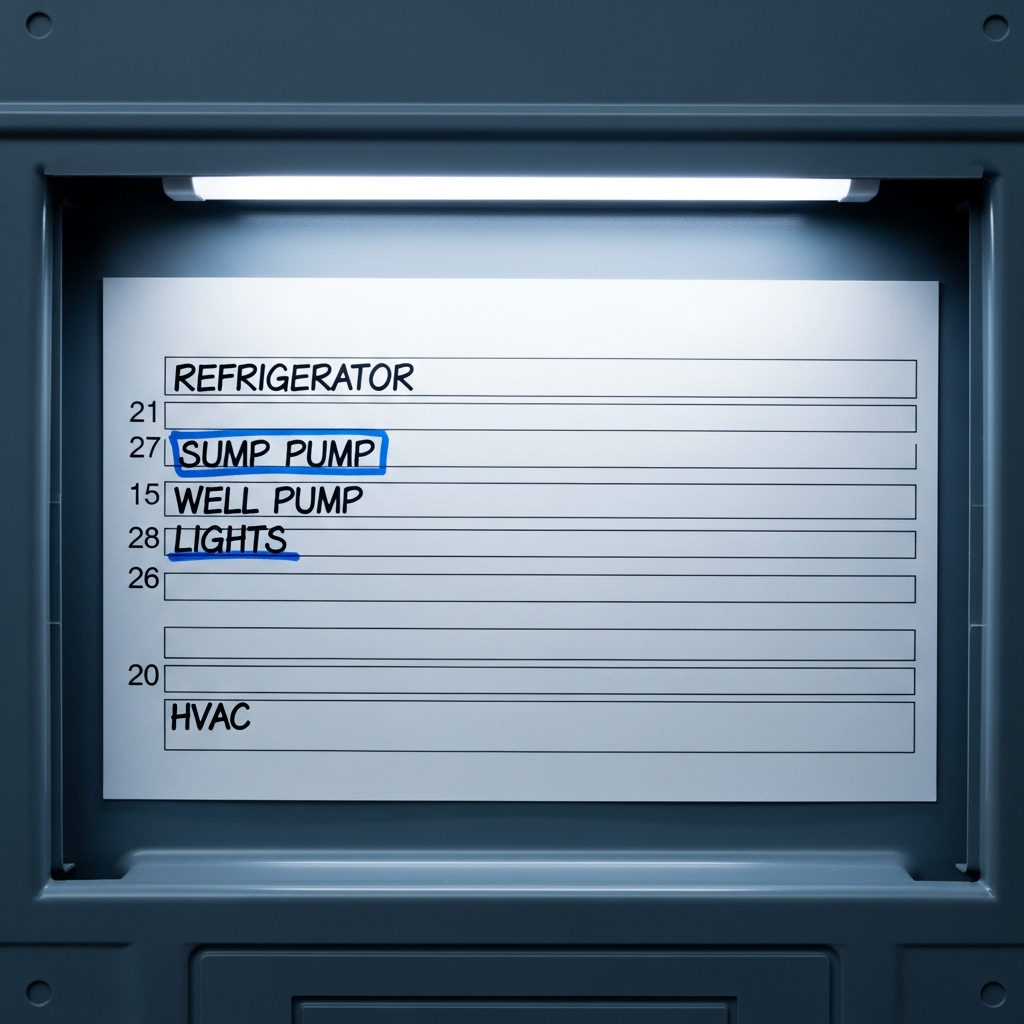
The most important appliances to power during an outage are medical equipment first, then your sump pump, well pump, refrigerator, freezer, and enough lighting to move safely through the house. That’s your entire list. Everything else — the central AC, the dryer, the dishwasher — goes on the “skip it” pile. The biggest savings in home backup power come from being honest about what you’ll actually use during an outage, not what you use on a normal Tuesday.
Most people overestimate what they need and buy accordingly. A $20,000 system when a $5,000 system would have covered everything that actually matters.
Before you run the numbers, use the home generator sizing calculator to build your full load list. But first you need to know what to put on that list.
Tier 1: life safety (non-negotiable)
These are the loads that cause real harm if they lose power. Budget them first, no exceptions.
Medical equipment. A standard CPAP draws 30 to 60 watts. A CPAP with a heated humidifier runs up to 120 watts. Either one is trivially easy to power — even a small portable battery system handles it. The reason it’s Tier 1 isn’t the wattage, it’s the consequence. If someone in your house needs a CPAP, an oxygen concentrator, a nebulizer, or a refrigerated medication like insulin, that load gets budgeted before everything else. An oxygen concentrator draws 300 to 600 watts. Home dialysis equipment can draw 1,000 watts or more. Know your numbers.
Sump pump. If you have a basement, your sump pump is probably the appliance that matters most in an outage. Power goes out during storms. Storms bring rain. A 1/3 hp sump pump draws roughly 480 watts running and surges to 1,440 watts at startup. A 1/2 hp pump draws 1,080 watts running and can surge to 3,000 watts. Basement flooding can cause $10,000 to $50,000 in damage. This one earns its place on the critical list.
Well pump. If your house is on a well, running water disappears when power goes out. A 1 hp submersible well pump draws 750 watts running and surges to 3,500 to 4,500 watts at startup. That startup surge is often the number that determines your minimum generator size. There’s a full breakdown of why surge matters in our guide to starting watts vs running watts.
Lighting for safe movement. Not every light in the house. A few LED circuits for kitchens, bathrooms, and hallways. Modern LED lighting is efficient — ten circuits of LED lights typically adds up to 200 to 400 watts total.
Smoke and CO detectors have their own battery backup. They don’t need to be on your generator circuit.
Tier 2: food safety and basic comfort
These matter for outages longer than 4 to 6 hours. Not emergencies, but real enough to plan for.
Refrigerator. A standard refrigerator draws about 100 to 200 watts running, but the compressor cycles on and off. It’s typically running about 8 minutes per hour. Average daily consumption is 1 to 2 kWh. An important fact that most people don’t know: a refrigerator can survive 4 to 6 hours without power if you keep the door closed. It doesn’t need to be your first load. If you’re choosing between refrigerator and something else on a small generator, the fridge can wait.
Chest freezer. Same principle. A chest freezer holds temperature even better than a refrigerator because cold air sinks. Keep it closed and it can hold safe temperatures for 24 to 48 hours depending on how full it is.
Phone and laptop charging. This is maybe 100 to 150 watts combined. Cheap to power, high return on investment when you need to reach people or get weather updates.
A small space heater for one room if your heat is electric and the weather is cold. A single 1,500-watt space heater can keep a small bedroom livable. The key word is one. Not the whole house.
Tier 3: skip these
This is where most backup power budgets go off the rails. People add Tier 3 loads and the system size doubles or triples.
Central air conditioning. A 3-ton central AC draws 3,500 watts running and surges to 10,000 to 12,000 watts at startup. Running it off a propane generator for a full day costs $20 to $40 in fuel. Running it for a week-long outage costs more than many people spend on their entire backup system. A better solution: one window unit (500 to 1,200 watts) for the bedroom where you actually sleep.
Electric dryer. 5,000 to 7,200 watts. Skip it. Hang things up or wait.
Electric oven and range. 2,000 to 5,000 watts for the oven, 1,000 to 2,500 watts per burner. Use a camping stove or a propane burner instead.
EV charger. A Level 2 charger draws 3,000 to 7,200 watts continuously. During an outage, your car has enough charge for local errands. It will keep.
Hot tub. 3,000 to 7,500 watts. This one goes straight to the bottom of the list, no discussion needed.
Dishwasher. 1,200 to 2,400 watts. Wash dishes by hand.
The refrigerator math people get wrong
A refrigerator cycling on 8 minutes per hour means it’s drawing full compressor wattage about 13% of the time. The average daily consumption of 1 to 2 kWh is real, but people look at the 400 to 600 watt startup surge and assume it’s always drawing that. It isn’t.
The practical implication: if you’re running a 3,500-watt generator and you’re debating whether to add the refrigerator or the AC, the refrigerator wins every time. The AC draws 3,500 watts continuously. The refrigerator draws 400 watts for a few minutes at a time. They are not remotely comparable loads.
The well pump reality check
If your house is on a well, this single appliance often sets the floor for what generator you need. Not because of running watts, but because of startup surge.
A 1 hp well pump drawing 750 watts running and surging to 4,500 watts at startup means your generator’s peak surge rating needs to be at least 4,500 watts while also handling everything else already running. If your survival-tier running load before the pump is 2,500 watts, your generator needs to handle a 7,000-watt startup event (2,500 + 4,500). A 5,500-watt generator won’t cut it. A 7,500-watt generator will, if the surge rating is high enough.
Check the surge/peak rating, not just the continuous rating.
Talking to your electrician about critical circuits
You don’t need to connect your whole electrical panel to backup power. You need to identify which breakers feed the loads that matter and connect only those.
Here’s what to do before the electrician arrives: walk your panel, read the circuit labels, and make a list of every breaker that controls a Tier 1 or Tier 2 appliance. If the labels are incomplete or wrong (they usually are), plug a lamp into each outlet and flip breakers until you’ve mapped things out. Bring that labeled list to the conversation.
The electrician wires those specific breakers to a critical-load subpanel connected to your transfer switch. Not the whole panel. Not the HVAC disconnect. Not the dryer. Just what’s on your list. That’s how you avoid oversizing the system and overpaying for capacity you’ll never use.
The full setup process is covered in our guide to the transfer switch subpanel.
If you want a portable option that handles Tier 1 and Tier 2 loads without a permanent install, a solar generator with enough battery capacity can cover most critical loads for 8 to 12 hours between charges.
Once you’ve built your priority list, run the actual load calculation — watts add up faster than you think. Here’s how to do the math: home generator sizing calculator.