Cummins home generator reviews
If you have a strong local Cummins dealer, I think Cummins is one of the better standby generator buys in the 20 kW class. The QuietConnect series has a real paper advantage on noise, remote diagnostics, and cold-weather prep, and the 13/17/20 kW models carry a 5-year / 2,000-hour limited warranty. That is the short answer.
The catch is service. When I read homeowner and installer threads about Cummins, the real anxiety is not “Will it start?” It is “Who fixes it after an ice storm?” Cummins itself pushes owners back to local authorized dealers for service and support, which means this brand rises or falls on the local shop in your county. If you are still deciding whether a permanent generator makes sense at all, start with the standby generator buying guide.
The short table
Here is my plain-English read on Cummins for a typical homeowner comparing quotes this week:
| What matters | What Cummins does well | Where I’d be careful |
|---|---|---|
| Noise | The RS20A / RS20AC spec sheet lists 65 dB(A) at 23 feet under normal load, which is better than a lot of 20-22 kW rivals on paper | Quiet brochures do not save a bad pad location. If HOA noise is your concern, read the quietest whole house generators for HOA compliance breakdown too |
| Cold-weather performance | Cummins calls out cold-weather readiness hard. The RS25 spec sheet even claims startup in conditions as low as -40 degrees F | Some cold-weather capability depends on the right accessories and setup. Do not assume the quote includes every heater and battery warmer you need |
| Warranty | The home generator FAQ says the 13, 17, and 20 kW models get 5 years / 2,000 hours | That same FAQ says the 25-125 kW residential and light-commercial units drop to a 2-year base warranty. That is a real gotcha |
| Controls | QuietConnect sells remote diagnostics, remote monitoring, and intelligent load management, not just a loud box on a pad | Fancy controls do not help if your local dealer barely supports the platform |
| Dealer reality | Cummins is a serious power company with a good reputation in commercial equipment | In residential standby, the service bench is usually thinner than Generac. Buy the local dealer, not the logo |
| Price | The premium is not insane. Sometimes it is only a few hundred dollars on hardware | It is still a premium, and installed pricing can widen fast if the dealer is scarce in your market |
Where Cummins earns its reputation
Cummins is not winning homeowners with flashy marketing. It is winning them with boring specs that matter during a real outage.
First, the noise numbers are genuinely good. The RS20A / RS20AC sheet says 65 dB(A) at 23 feet, plus a low-speed exercise mode and even a crank-only exercise option. If you have been reading generator spec sheets for a while, you know that 65 in the 20 kW class is not common. That is why Cummins showed up near the top of our quietest generator shortlist.
Second, Cummins clearly builds for ugly weather. On the QuietConnect marketing page, Cummins leans hard on remote diagnostics, sound attenuation, and durability. The RS25 sheet goes further with a much heavier package, a 1,109-pound enclosure, 1,800 RPM operation, and that aggressive cold-start claim. If you live in Minnesota, Maine, or the mountain West, that part of the pitch is not fluff. Cold starts are where standby generators earn their keep.
Third, the smaller residential models get a cleaner warranty story than I expected. The FAQ says the 13, 17, and 20 kW units carry 5 years or 2,000 hours. I like hour caps in generator warranties because they force everybody to talk about real use instead of pretending outage runtime does not matter. It is still a limited warranty, not magic. But it is a respectable starting point.
The 25 kW model is not the same conversation
A lot of buyers lump all Cummins home generators together. I would not.
The 13, 17, and 20 kW units are the mainstream residential play. They are compact, relatively quiet, and clearly aimed at the homeowner who wants a polished standby package with automatic transfer and load-management options. The RS25 is a different beast. It is larger, slower-turning, and marketed into residential plus light-commercial work. It is also where the base warranty gets worse.
That matters because some homeowners get upsold into 25 kW just because the dealer likes large numbers. If your actual outage plan is a well pump, fridge, freezer, lights, internet, and one central air unit with proper load management, you may not need to jump into that class at all. Run the math in the home generator sizing calculator before you let anybody sell you a bigger fuel bill.
Where Cummins gets harder to recommend
This is where the review stops being a spec-sheet love letter.
Cummins does not enjoy the same residential default status as Generac. That means fewer dealers in a lot of suburban markets, fewer technicians who touch these units every week, and a higher chance that your support experience depends on one shop instead of three competing shops. In standby generators, that is a huge deal. The machine is married to annual maintenance, firmware updates, warranty visits, and storm-season repair calls.
Price is the other issue. On May 13, 2026, Buckeye Power Systems listed the Cummins RS20AC kit at $6,864.92. The same day, The Tool Shack listed a Generac 22 kW Guardian package at $6,147.00. That is not a ridiculous gap, but it is not a rounding error either.
The bigger problem is what happens after the sticker price. If the Cummins dealer is farther away, has a smaller service team, or bundles pricier annual maintenance, the ownership gap can widen over time. That is why I would compare Cummins against the practical default, not against a fantasy spec sheet. Our Generac vs Kohler whole house generators piece lands on the same principle: dealer strength often matters more than the brand mythology.
Who should buy Cummins
I would put Cummins high on the shortlist for these homeowners:
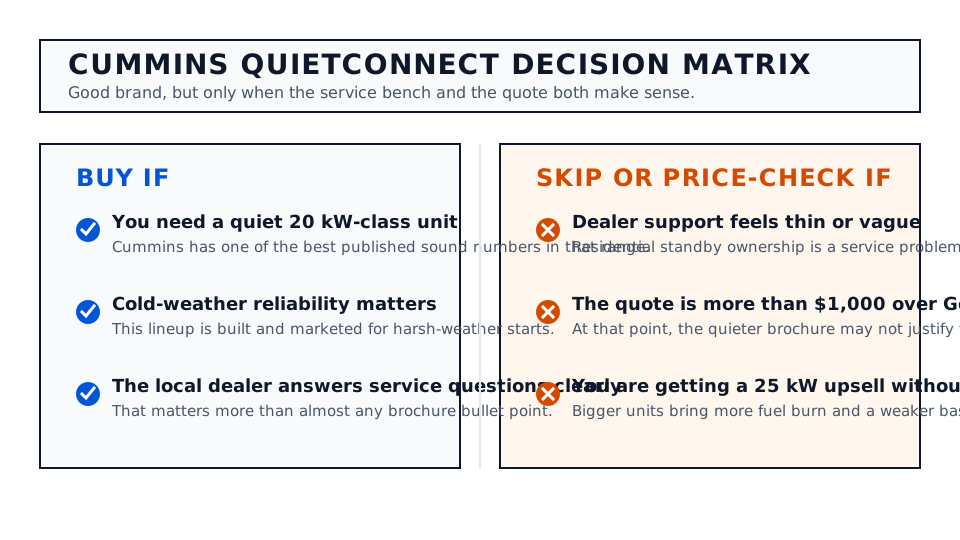
- You need a real 20 kW-class standby unit and want one of the quieter published numbers in that range
- You live in a cold climate where startup reliability matters more than squeezing the lowest possible quote
- Your local Cummins dealer is established, answers warranty questions cleanly, and already services units nearby
- You care about remote monitoring and load management, not just raw generator size
That is the buyer profile where Cummins makes sense. In that lane, the brand has a real case.
Who should skip it
I would move on quickly if any of these are true:
- The dealer cannot tell you who handles warranty work during storm season
- The Cummins quote is more than about $1,000 above a comparable Generac setup with the same transfer-switch scope
- You are being pushed into the 25 kW class without a real load calculation
- You want the easiest parts-and-service path in a typical suburb and do not care about shaving a couple dB off the spec sheet
That last point matters. If you want the boring, safe default in residential standby, Generac still owns that conversation because the service ecosystem is so much deeper.
The questions I would ask before signing
If you are holding a Cummins quote right now, ask these five questions in this order:
- “Who performs warranty work in my zip code, and what is the normal response time after a major storm?”
- “Does this quote include every cold-weather accessory required for my climate, or are those add-ons?”
- “What is the published normal-load sound rating for this exact model, and where will the pad sit relative to my property line?”
- “What annual maintenance is required to keep the warranty clean, and what does that visit cost in writing?”
- “Can you show me the actual load calculation that justifies this kW size?”
Weak dealers hate those questions. Good dealers answer them in two minutes.
My take
Cummins home generators are good. In the 20 kW class, I think they are better than good if you care about quiet operation and cold-weather confidence. But this is not a brand I would buy blind from a weak dealer just because the brochure looks sharper than Generac’s.
Run your loads through the home generator sizing calculator, then make the Cummins dealer answer the service question in writing. If that answer is solid, Cummins deserves the quote. If it is slippery, buy the better support network and sleep better.