Are portable power stations eligible for tax credit?
Yes, but only if two conditions are met: the battery has a nameplate capacity of at least 3 kilowatt-hours, and it is installed in connection with your home’s electrical system. Most portable power stations fail one or both of those tests. The ones that pass can save you 30% on hardware and installation costs through the federal Residential Clean Energy Credit.
This is one of the most confusing corners of the Inflation Reduction Act because the IRS doesn’t specifically say “portable power stations.” It says “battery storage technology.” Whether your particular unit qualifies depends on its specs and how it’s connected to your house. Our battery storage tax credit guide covers the full credit in detail. This article focuses specifically on the portable power station question.
The two IRS requirements that matter
The Residential Clean Energy Credit (Section 25D, claimed on IRS Form 5695) covers “qualified battery storage technology.” To qualify, the battery must:
- Have a capacity of at least 3 kilowatt-hours
- Be installed in connection with a dwelling unit located in the United States
Both requirements must be met. Meeting one but not the other gets you nothing.
The 3kWh capacity rule
This is a hard cutoff. 2.9kWh doesn’t round up. There’s no partial credit. The IRS set this threshold to exclude small UPS units and camping-grade batteries from the credit. It’s a clean, objective test: check the spec sheet, compare the number.
Here’s where popular portable power stations land:
Above 3kWh (passes the capacity test):
- EcoFlow Delta Pro: 3.6kWh
- EcoFlow Delta Pro Ultra: 6.0kWh per unit
- Anker Solix F3800: 3.84kWh
- Bluetti AC300 + B300: 3.07kWh (the AC300 has no internal battery; the B300 expansion unit provides the capacity)
- Bluetti EP500: 5.1kWh
Below 3kWh (fails, no credit):
- EcoFlow Delta 2 Max: 2.0kWh
- Jackery Explorer 2000 Plus: 2.0kWh
- Bluetti AC200MAX (standalone): 2.0kWh
- Goal Zero Yeti 3000X: 2.98kWh
- Jackery Explorer 1000: 1.0kWh
That Goal Zero Yeti 3000X is painful. It’s 20 watt-hours short of the threshold. No credit.
If you’re considering a unit that’s close to 3kWh, check whether expansion batteries push it over. An AC200MAX alone at 2.0kWh doesn’t qualify. Add a B300 expansion pack (3.07kWh), and the combined system crosses the line. But read the next requirement carefully before you get excited.
The “installed in connection with” requirement
This is where it gets murky. The IRS doesn’t define “installed in connection with a dwelling unit” with surgical precision for portable batteries. The language was written for permanently mounted systems like the Tesla Powerwall and Enphase IQ. It clearly covers batteries that are hardwired into your home’s electrical panel by a licensed electrician. Those are installed. No ambiguity.
Portable power stations occupy a gray area. The IRS hasn’t issued specific guidance saying “a portable unit plugged into a wall outlet counts” or “a portable unit connected via a transfer switch counts.” What we know:
Strongest case for eligibility: A portable power station that is connected to your home’s electrical panel through a transfer switch, interlock kit, or manufacturer-specific integration panel (like EcoFlow’s Smart Home Panel or Anker’s Home Power Panel). This setup involves licensed electrician work, permits, and a permanent physical connection between the battery and the home. It functionally behaves like a permanently installed system, even though the battery unit itself can be unplugged.
Weakest case for eligibility: A portable power station sitting on a shelf, plugged into a standard wall outlet or running extension cords to individual appliances. No connection to the home’s electrical system. No installation labor. This is just a large battery you own. It’s hard to argue this meets the “installed in connection with” standard.
The middle ground: The unit is physically placed in the home, connected to a transfer switch or interlock kit, and used exclusively for home backup. You could technically pick it up and carry it outside. But it’s functionally integrated into the home’s power system.
What the manufacturers say
EcoFlow, Anker, and Bluetti have all published statements or FAQ pages indicating that their products may qualify for the Residential Clean Energy Credit. The key word is “may.” No manufacturer guarantees you’ll get the credit. They can’t, because the IRS hasn’t issued definitive portable-specific guidance.
EcoFlow is the most aggressive about this. Their marketing explicitly positions the Delta Pro Ultra as eligible when installed as a whole-home backup system through their Smart Home Panel. The Delta Pro Ultra is also the easiest case to make: it’s a 6kWh+ system designed for permanent home integration, sold with a dedicated sub-panel, and typically installed by a licensed electrician. It behaves like a Powerwall that happens to be modular.
Anker positions the Solix F3800 similarly when installed with their Home Power Panel. The F3800 at 3.84kWh clears the capacity bar, and the Home Power Panel connection gives it the “installed in connection with” argument.
No manufacturer will fight the IRS on your behalf if your claim gets questioned. Get a tax professional’s opinion before filing.
What you can include in the credit calculation
If your portable power station does qualify, the 30% credit applies to the total installed cost. That includes:
- The battery unit itself
- Expansion batteries (if they push total capacity above 3kWh)
- The transfer switch, interlock kit, or smart panel used to connect it
- Licensed electrician labor for the installation
- Permits and inspection fees
- Wiring and conduit materials
It does not include solar panels (those go on a different line of Form 5695), extended warranties, monitoring subscriptions, or shipping costs.
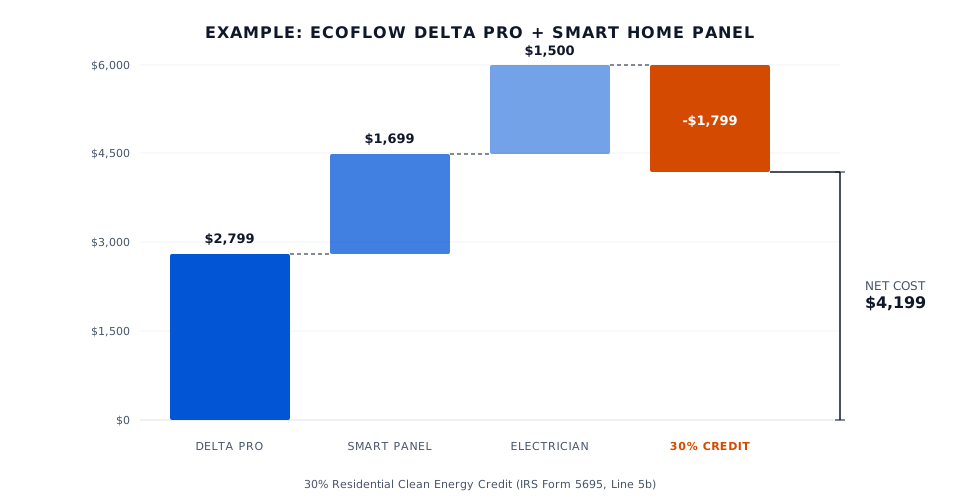
A concrete example: you buy an EcoFlow Delta Pro ($2,799) plus a Smart Home Panel ($1,699), and your electrician charges $1,500 for installation and permitting. Total: $5,998. At 30%, that’s $1,799 back on your federal taxes.
How to give yourself the strongest claim
If you want to claim the credit for a portable power station, here’s how to build the strongest possible case:
Buy a unit above 3kWh. Not barely above. Comfortably above. The EcoFlow Delta Pro (3.6kWh), Anker F3800 (3.84kWh), and EcoFlow Delta Pro Ultra (6kWh+) all clear this easily.
Connect it through a transfer switch or smart panel. This is the single most important step. A portable unit connected to your home panel through proper switching hardware has a much stronger “installed in connection with” argument than one running extension cords. Our transfer switch guide covers your options.
Have a licensed electrician do the installation. The electrician’s invoice is documentation that the system was professionally installed in connection with your home. Keep the invoice. It should itemize hardware and labor separately.
Pull a permit. The electrical permit and inspection record prove the installation date, the installation location (your home), and that the work met code. This is the cleanest documentation if you’re ever audited.
Save the manufacturer’s certificate of eligibility. Most manufacturers provide a downloadable document confirming the battery meets the IRS capacity requirement. Download it and keep it with your tax records.
Keep the system in your home. If you take it camping every weekend and claim it as a home energy credit, that’s a problem. The credit is for battery storage installed in connection with a dwelling unit. If the battery spends most of its life in an RV or at a campsite, you’re on thin ice.
Talk to a tax professional. ShelterVolt is a system design guide, not a CPA firm. The rules here are accurate as of publication, but the “installed in connection with” question for portable units is genuinely ambiguous in current IRS guidance. A tax professional can evaluate your specific setup and advise you on whether your claim will hold up. The cost of a consultation is a fraction of the credit you’re claiming.
The bottom line on portable vs. permanently installed
If you’re buying a portable power station primarily for home backup and you’re planning to connect it through a transfer switch anyway, the tax credit argument is strong. You’re spending the money on proper installation regardless. The credit just makes it 30% cheaper.
If you’re buying a portable unit because you want something you can grab and take anywhere, with no permanent connection to your home panel, the credit probably doesn’t apply. You can still claim it if you install it in connection with your home later, but the IRS cares about how it’s set up when you place it in service.
The math matters either way. Use the home generator sizing calculator to figure out exactly how much capacity you need before you shop, and check the battery storage tax credit guide for the full picture on credits, state programs, and how to file Form 5695.