Interlock kit vs transfer switch
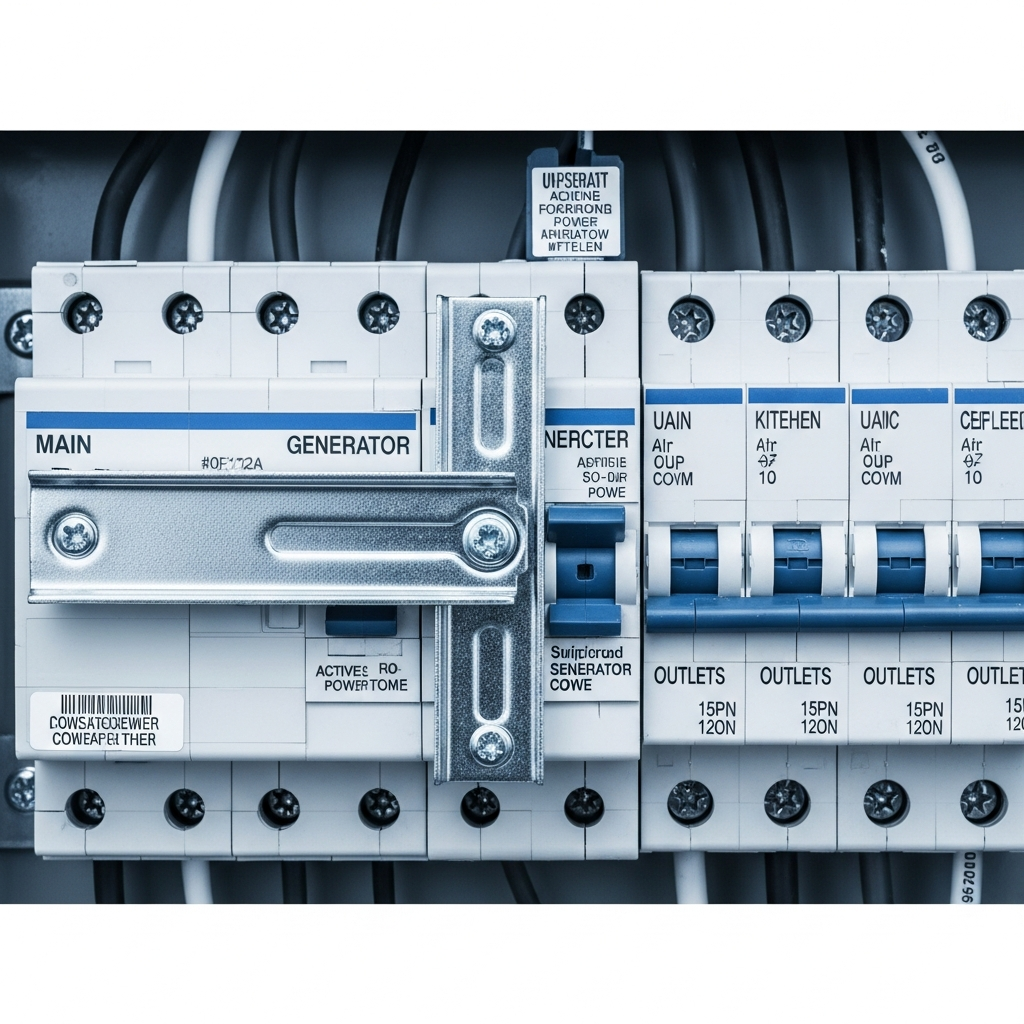
An interlock kit is the right call if you have a portable generator, a tight budget, and a local authority that permits it. A manual transfer switch subpanel makes more sense when you want pre-labeled critical circuits or your jurisdiction won’t approve an interlock. Either way, you need a licensed electrician to install it — this is not a weekend project.
If you’re earlier in your research and haven’t committed to a connection method yet, read the full transfer switch for generator guide first. It covers all three options — interlock, manual switch, and automatic transfer switch — with the tradeoffs spelled out before you spend a dollar.
What an interlock kit actually is
An interlock kit is a metal plate that attaches to the outside of your existing main breaker panel. It works through a simple sliding bracket: when your main utility breaker is in the ON position, the bracket physically blocks the generator input breaker from turning on. Flip the main off, slide the bracket, and now the generator breaker can go on — but the main is physically blocked from turning on while it’s running.
No electronics. No relays. No automatic switching of any kind. You do everything manually: shut off the main, connect your generator via a transfer inlet box on the exterior of your house, slide the bracket, flip the generator breaker on, then go circuit by circuit turning off the loads you don’t need.
That’s the whole system. A piece of stamped metal and a pair of breakers.
How the installation works
The interlock kit pairs with a generator inlet box — typically a NEMA L14-30 (30-amp, 240V) or L14-50 (50-amp, 240V) outlet mounted on the exterior of your house. A 4-wire cord connects your generator to that inlet. Inside the panel, the electrician adds a double-pole breaker (usually 30A or 50A) wired back to that inlet box, then installs the interlock bracket over the main breaker and the new generator breaker.
When you need generator power, the sequence is:
- Start the generator and let it warm up
- Go to your main panel, shut off all individual circuit breakers
- Flip the main utility breaker OFF
- Slide the interlock bracket to the generator position
- Flip the generator breaker ON
- Turn on individual circuits one by one, watching your generator’s load meter
That last step matters. You can’t just flip everything on at once — especially if you have a well pump or air conditioner, where starting watts spike 2-3x the running load. Bring circuits up slowly.
Is an interlock kit legal?
This is the most important question before you buy anything.
NEC Article 702.6 covers optional standby systems and requires that transfer equipment prevent two power sources from being connected simultaneously. A properly installed interlock kit meets this requirement — the mechanical bracket makes it physically impossible to have both sources energized at the same time.
The problem is that NEC is a model code, not federal law. Local jurisdictions adopt it (sometimes with amendments) and their Authority Having Jurisdiction (AHJ) — usually the local building department or electrical inspector — has final say. Some AHJs require a listed transfer switch, which means a device that’s been specifically tested and certified as transfer equipment. Most interlock kits carry a UL listing, but not always as “transfer switches” per se.
Call your local building department before you buy anything. Ask specifically: “Does my jurisdiction allow a generator interlock kit on a residential main panel, or do you require a listed transfer switch?” One phone call. That’s it.
If your AHJ says no to interlock kits, skip the rest of this article and go straight to a manual transfer switch subpanel.
Cost comparison
Here’s the honest math:
| Option | Hardware | Electrician labor | Total installed |
|---|---|---|---|
| Interlock kit | $50–$150 | $150–$300 | $200–$450 |
| Manual transfer switch (8-circuit subpanel) | $300–$600 | $400–$800 | $700–$1,400 |
| Automatic transfer switch | $500–$2,000 | $500–$1,500 | $1,000–$3,500+ |
The labor spread on interlock kits is wide because it depends heavily on where your panel is and how much conduit work the inlet box requires. A panel right next to an exterior wall with easy access might be a 2-hour job. A finished basement with a long conduit run to the other side of the house is a different story.
Get two quotes.
Interlock kit: pros
Covers the entire panel. This is the biggest thing people miss. With an interlock kit, every circuit in your panel is available during an outage. You’re not limited to 8 pre-selected circuits. If your generator can handle it and sizing your generator correctly shows you have headroom, you can run your refrigerator, a few lights, the well pump, and a window AC unit — circuits that might not have made the cut on an 8-circuit subpanel.
Simple and reliable. No electronics, no relay boards, no solenoids that can fail. A metal bracket that slides. It’ll work in 30 years exactly the same as it does today.
Works with any portable generator that has a 4-prong outlet (L14-30 or L14-50). You’re not locked into a specific brand or model.
Cheapest option by a significant margin. The $500+ you save over a subpanel install is real money.
Interlock kit: cons
You have to be home. There’s no automation. If a tree falls on a line at 3am while you’re traveling, nobody’s running the generator — and your sump pump isn’t running either.
Manual process has steps that can be done wrong. If someone forgets to flip the main utility breaker off before energizing the generator breaker, you’ve got a serious backfeed problem. A properly installed interlock makes this physically impossible, which is the whole point — but only if the installer did it right.
Some local codes don’t allow it. Covered above. Check first.
Does NOT work with standby generators. Whole-home standby generators (Generac, Kohler, etc.) require an automatic transfer switch. An interlock kit is only for portable generators connected manually.
Manual transfer switch subpanel: pros
Pre-labeled critical circuits. The electrician runs dedicated wires from your most important circuits — refrigerator, well pump, furnace, a few lights — to the subpanel at install time. During an outage, flip one switch per circuit. It’s simpler to operate, especially if someone in your household isn’t comfortable reading panel labels.
Clearly defined load. Because the subpanel only has 8–10 circuits, you know exactly what your generator needs to power when those breakers are on. Less chance of accidentally overloading the generator by turning on too much.
Often preferred by code. If your AHJ is strict about interlock kits, a listed manual transfer switch is the straightforward path to a permit.
Manual transfer switch subpanel: cons
Costs $700–$1,400 installed. For most households with portable generators, this is the only real downside — but it’s a significant one.
Limited to the circuits wired to it. You pick 8 circuits at install time. If you didn’t include the circuit to your deep freeze, that freeze isn’t getting power. You can’t easily change this later without more electrician work.
Still requires a generator inlet box. The subpanel doesn’t eliminate the inlet box — you still need the exterior receptacle and the cord run to your generator. The cost of the inlet box installation is essentially the same either way.
When an interlock kit makes sense
- You have a portable generator and want to use your whole panel
- Budget is tight and you want to keep total cost under $500
- You’re comfortable with the manual switching sequence
- Your local AHJ accepts interlock kits (verify this first)
- You want flexibility to add a larger generator later without rewiring
When a manual transfer switch makes sense
- Your local code requires a listed transfer switch
- You have family members who need a labeled, simplified system
- You want critical circuits clearly defined and separated at the panel
- You’re already spending money on a more capable installation and the cost delta is acceptable
This work requires a licensed electrician. An interlock kit is inexpensive hardware, but the installation involves opening your main panel — live bus bars, exposed feeders, the full line voltage from your utility feed. This is not a DIY job under any circumstances. The electrician also pulls the permit and gets the work inspected, which matters when you sell the house or file an insurance claim.
The automatic transfer switch
Worth a brief note: if you have or are planning a whole-home standby generator, neither of the above applies. Standby generators require an automatic transfer switch (ATS) that senses an outage and switches sources without you touching anything. Those run $1,000–$3,500+ installed and are a different category entirely. An interlock kit cannot connect to a standby generator.
Before you buy either option, confirm your AHJ allows interlock kits — one phone call to your local building department saves a $500 mistake. And make sure your portable generator is sized correctly for your critical loads first: home generator sizing calculator.