Enphase IQ Battery vs Tesla Powerwall
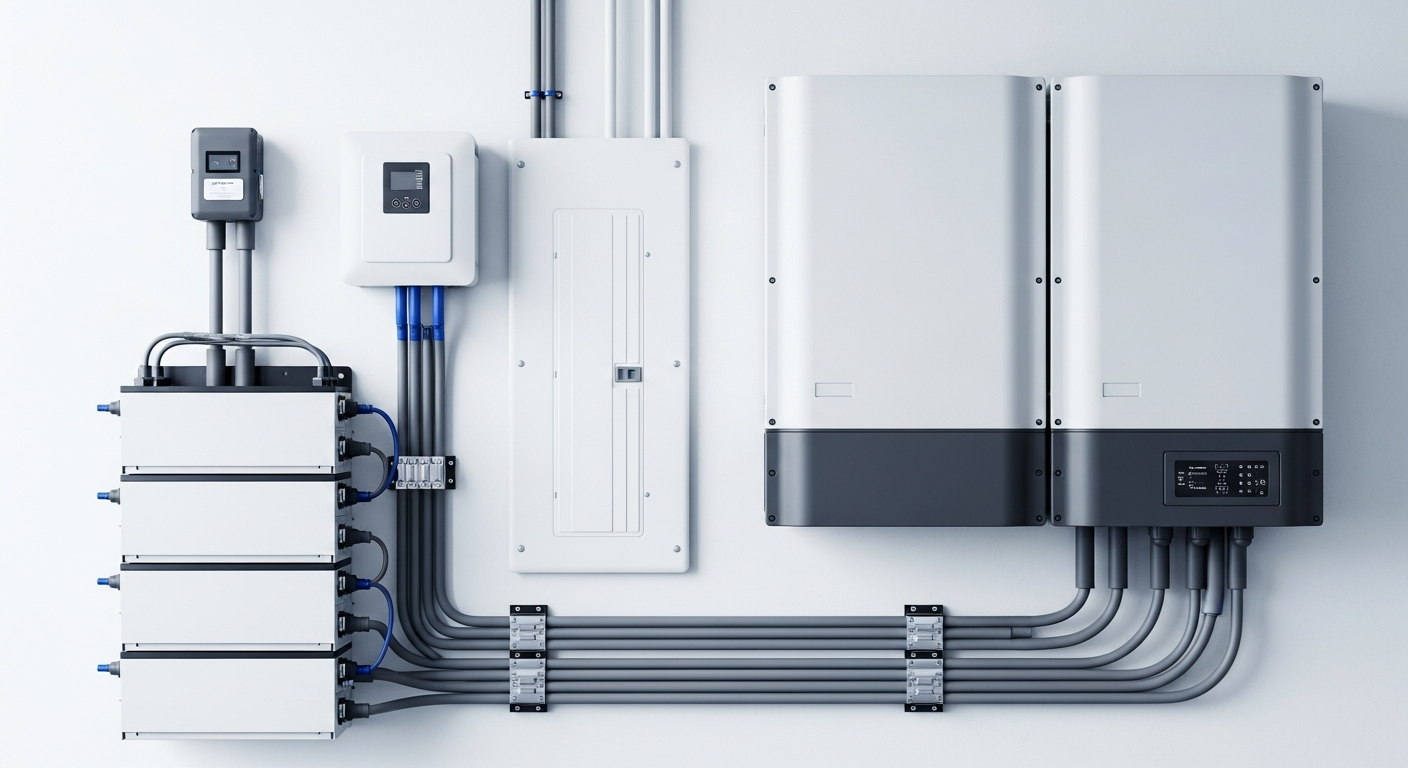
If you already have Enphase microinverters on your roof, the Enphase IQ Battery 5P is usually the cleaner buy. If you’re starting from scratch and want the most backup power from one wall box, Tesla Powerwall 3 is the better answer. That’s the short version.
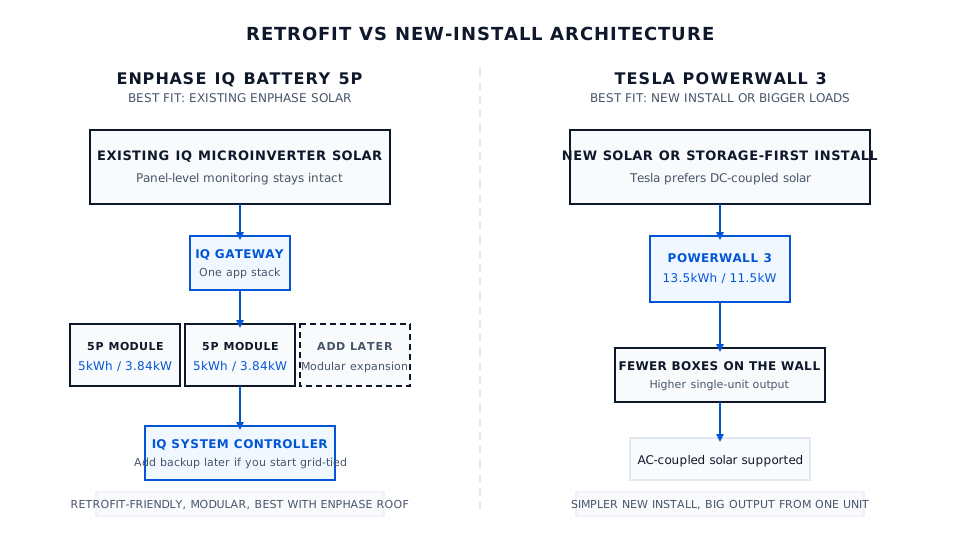
These systems are not close cousins. The Enphase 5P is a modular AC-coupled battery built to slide into the Enphase ecosystem. Powerwall 3 is a 13.5kWh battery with a built-in hybrid inverter and much higher single-unit output. Same category, different logic.
For the bigger shortlist, start with our best whole house battery backup systems guide. This article is the head-to-head for these two specifically.
Start with the architecture, not the logo
The Enphase IQ Battery 5P data sheet lists 5.0kWh usable capacity, 3.84kW continuous output, and a 15-year limited warranty per module. The Tesla Powerwall 3 data sheet lists 13.5kWh usable capacity, 11.5kW continuous output, and a 10-year limited warranty. Those numbers tell you most of what matters.
| Spec | Enphase IQ Battery 5P | Tesla Powerwall 3 |
|---|---|---|
| Usable capacity | 5.0kWh per unit | 13.5kWh per unit |
| Continuous output | 3.84kW per unit | 11.5kW |
| Motor starting | 7.68kW peak / 48A LRA | 185A LRA motor start |
| Architecture | AC-coupled, embedded microinverters | Hybrid inverter, DC-coupled preferred |
| Best fit | Existing Enphase solar, modular expansion | New installs, high-load backup |
| Warranty | 15 years | 10 years |
The Enphase system grows in 5kWh chunks. Powerwall 3 starts bigger and hits harder right away. That’s why the right question is not “Which brand is better?” It’s “Do I need modular retrofit flexibility or one-box muscle?”
Powerwall 3 wins on one-box muscle
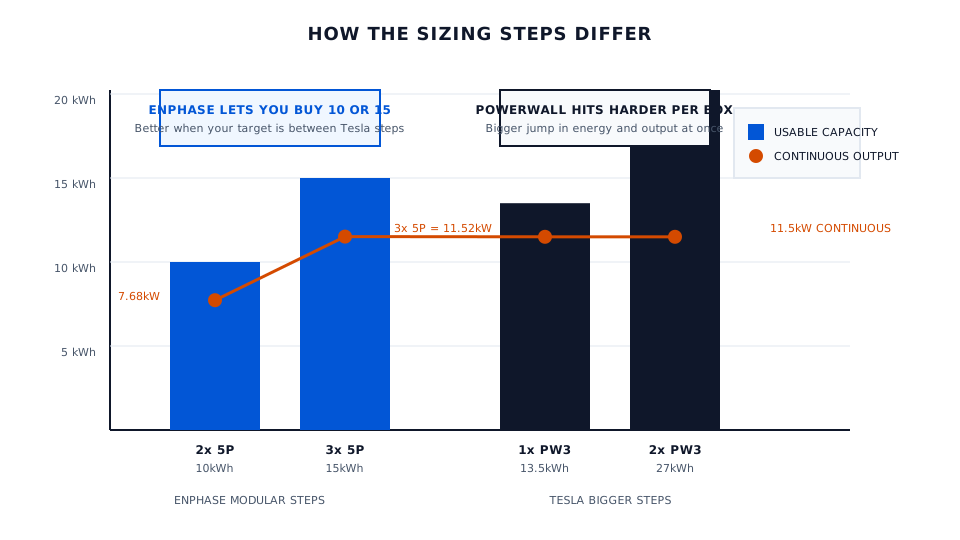
One Powerwall 3 gives you almost the same continuous power as three Enphase 5Ps. That’s the whole story for buyers who want to back up central AC, a well pump, kitchen circuits, and a few 240V loads without covering the garage wall in battery boxes.
Three Enphase 5Ps add up to 15kWh and 11.52kW continuous. That’s basically Powerwall 3 territory on output, but it takes three battery modules, more mounting space, and usually more labor. If your outage plan includes compressor loads, study starting watts vs running watts before you get too excited by a 5kWh module price.
Tesla also gives you more headroom per box when the house has ugly surge loads. The 185A locked-rotor motor start number on the official spec sheet is there for a reason. It is built for the homeowner who wants fewer compromises during an outage.
Enphase wins the retrofit argument
This is where Enphase gets hard to dismiss.
Enphase says the IQ Battery 5P can be configured for self-consumption, savings, or full backup, and it can even be installed as a grid-tied battery first and upgraded to backup later by adding the system controller. If your house already has Enphase microinverters, that means one monitoring stack, one installer ecosystem, and one app that already knows what every panel is doing.
Powerwall 3 can absolutely work with existing AC-coupled solar. But Tesla’s own AC-coupled solar design guide says DC-coupled solar connected directly to Powerwall 3 is “strongly preferred” because it uses less equipment and is more efficient. That’s Tesla telling you, in polite engineer language, that Powerwall 3 makes the most sense when it is the center of the system.
So if you already own an Enphase roof, the 5P usually fits better. You keep panel-level monitoring. You keep the Enphase app. And you avoid paying for a Powerwall 3 hybrid inverter that is no longer the star of the show.
The app difference is simpler than people make it
Tesla’s app is cleaner. For most homeowners, it is the easier app to live with.
You get Self-Powered mode, Time-Based Control, and Storm Watch, which automatically tops the battery off ahead of severe weather. The interface is straightforward. Your spouse can use it. That matters more than battery nerds like to admit.
The Enphase app is deeper if you already live in the Enphase world. Enphase supports Self-Consumption, Savings, and Full Backup profiles for the 5P platform, and the Enphase App keeps adding more Storm Guard, monitoring, and battery-control features. If your house already has Enphase solar, the app’s panel-level visibility is genuinely useful. You can see exactly what the roof is doing, what the battery is doing, and where the energy is going without jumping between apps.
My blunt take: if you open the app twice a year, Tesla wins. If you already track panel production and want a more granular home-energy dashboard, Enphase wins.
Reliability: nobody has the clean failure-rate dataset you want
This is where the internet gets sloppy.
Neither company publishes a homeowner-friendly, apples-to-apples field failure rate that lets you declare a clear winner. Installer anecdotes are not useless, but they are not clean data either. So I would not make a five-figure battery decision based on somebody in a forum saying “Brand X always fails.”
What you can compare is the failure shape.
Enphase spreads the system across multiple smaller battery modules with embedded microinverters. If one module has a problem, the rest of the stack can still operate. That’s a real resilience advantage.
Tesla goes the other direction. Fewer boxes. Fewer connections. More output per wall footprint. On a fresh install, that simplicity can reduce install mistakes, and install mistakes cause a lot of the “reliability” complaints homeowners blame on hardware.
So which has the better failure rate? The honest answer is that the public data is too thin to say. Which has the better failure shape? Enphase if you hate single points of failure. Tesla if you want fewer components and a simpler new install.
The real price difference
On raw cost per stored kilowatt-hour, Tesla usually wins.
EnergySage’s battery marketplace data puts Enphase around $1,344 per kWh and Powerwall around $1,000 to $1,065 per kWh on typical installed quotes. That tracks with what installers quote in the real world: Powerwall 3 is usually the cheaper way to buy a lot of backup in one shot.
But Enphase can still be the cheaper answer when your ideal system size is awkward.
If your load math says you need about 10kWh for essentials, two 5Ps gets you there without buying 13.5kWh. If your target is closer to 15kWh, three 5Ps lands almost perfectly while one Powerwall is short on energy and two Powerwalls may be more battery than you wanted to pay for. Enphase is expensive per kWh, but it lets you buy in smaller bites.
That sizing flexibility is not theoretical. It changes the quote.
Here’s the practical way to think about it:
- If you want the cheapest path to big output and whole-home feel, Powerwall 3 usually wins.
- If you want a 10kWh or 15kWh backup plan that matches an existing Enphase roof, the 5P can make more sense despite the worse $/kWh math.
The lock-in is real on both sides
Both companies want the whole relationship.
Enphase lock-in is obvious: Enphase batteries, Enphase gateway, Enphase controller, Enphase app, Enphase installer training. The good news is that this lock-in feels pretty reasonable if you already own Enphase solar. You’re staying inside a system that already exists on your house.
Tesla lock-in is different. Powerwall 3 supports AC-coupled solar, but Tesla’s preferred design keeps Tesla hardware at the center of the power path, the app, and the backup logic. That’s efficient on a new install. It’s less friendly when you’re trying to graft Tesla onto somebody else’s solar architecture.
My opinion: Enphase has the friendlier lock-in for retrofit buyers. Tesla has the stronger lock-in for new-install buyers. Neither one is an open playground where you mix brands however you want.
My bottom line
If your roof already runs on Enphase, buy the Enphase IQ Battery 5P unless the price gap is absurd. The integration is cleaner, the monitoring is better, and the modular sizing makes sense.
If you’re building new or you want the most backup power from the fewest boxes, buy Tesla Powerwall 3. One unit does a lot of work.
If you’re stuck between the two after all of this, break the tie by installer quality in your ZIP code. The better local install and service network is worth more than brand tribalism.
Now do the boring part that saves the most money: list the exact loads you want to back up, then run them through the home generator sizing calculator. That’s how you stop overbuying battery.