EcoFlow Delta Pro Ultra review for home backup
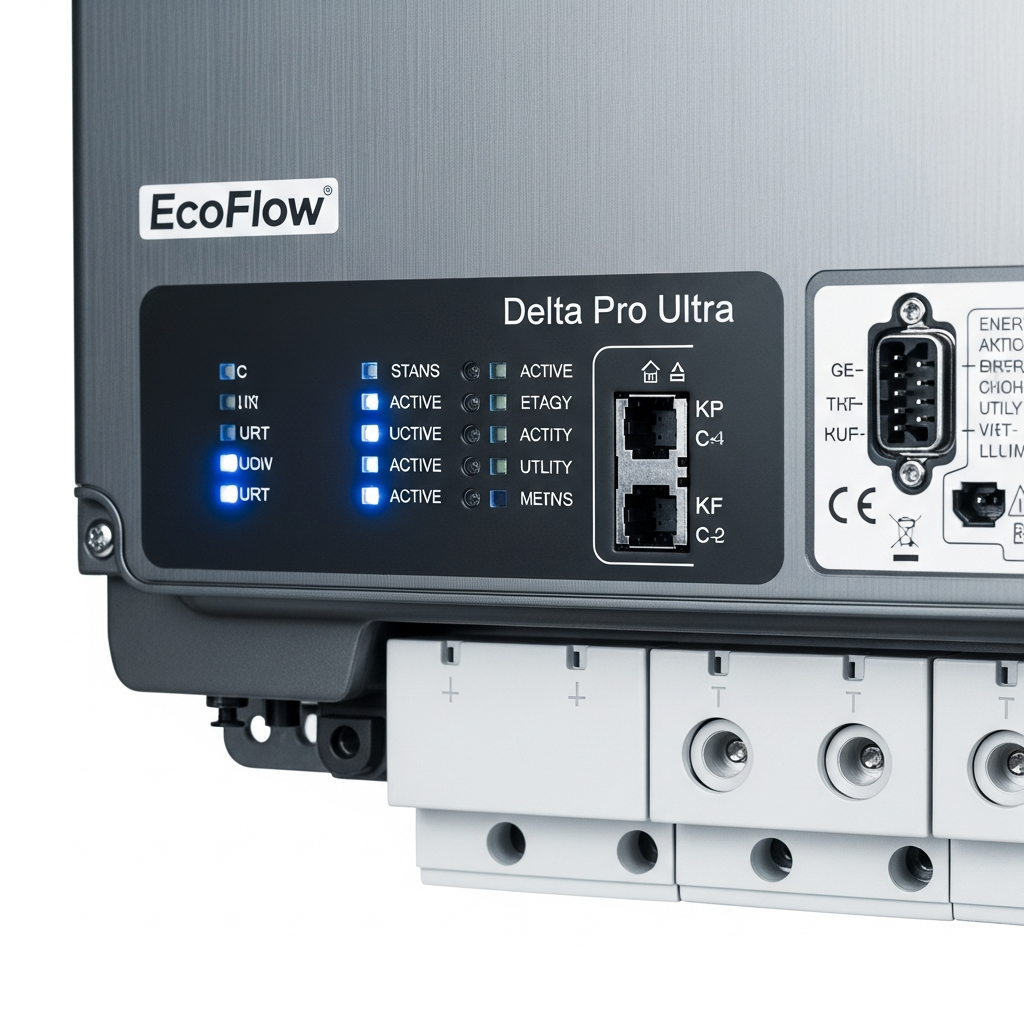
The EcoFlow Delta Pro Ultra is not a portable power station that happens to plug into your house. It’s a modular home battery system that happens to be portable before you install it. That distinction matters, because how you evaluate it changes completely once you stop thinking of it as a camping gadget and start thinking of it as infrastructure.
I’ve spent time with this system connected to a subpanel through the Smart Home Panel 2, running real loads — refrigerator, well pump, network gear, and yes, a 3-ton AC compressor. This review evaluates the Delta Pro Ultra exclusively as a permanent home backup fixture. If you want a review of it sitting on a tailgate at a campsite, this isn’t it.
For context on how this system fits against the competition, read our best whole house battery backup systems comparison first. This article goes deeper on EcoFlow specifically.
The specs that actually matter
Here’s what the Delta Pro Ultra delivers per inverter-and-battery unit:
| Spec | Value |
|---|---|
| Battery capacity (per module) | 6,144Wh (6kWh) |
| Max expansion | 90kWh (15 battery modules across 3 inverters) |
| Continuous AC output | 7,200W (7.2kW) per inverter |
| Surge output | 10,800W (10.8kW) per inverter |
| AC output voltage | 120V/240V split-phase |
| Battery chemistry | LFP (LiFePO4) |
| Cycle life | 3,500+ cycles to 80% capacity |
| Solar input | 5,600W per inverter (two PV ports) |
| AC charging speed | Up to 8,800W (two batteries in ~2 hours) |
| Transfer switch time | 20ms (via Smart Home Panel 2) |
| Inverter weight | 70 lbs (31.7 kg) |
| Battery weight | 112 lbs (50.7 kg) |
Two numbers jump off this table. First, 7.2kW continuous per inverter. That’s enough to start and run a 3-ton central AC compressor, which typically surges to 9,000-12,000 starting watts but settles to around 3,500W running. The 10.8kW surge rating handles the startup spike. Stack two inverters and you’re running 14.4kW continuous with 21.6kW surge — that covers almost any residential load combination you’ll throw at it.
Second, the 20ms transfer time through the Smart Home Panel 2. That’s fast enough that your refrigerator compressor doesn’t even stutter. Most clocks won’t reset. It’s not true UPS-grade (which is under 10ms), but it’s well within the tolerance of every residential appliance.
The Smart Home Panel 2 is the real product
Buy the Delta Pro Ultra without the Smart Home Panel 2 and you have an expensive portable power station. Buy it with the Smart Home Panel 2 and you have a whole-home backup system. The panel is what makes this a home fixture.
The Smart Home Panel 2 installs between your main breaker panel and up to 12 individual circuits. Your licensed electrician wires it into the circuits you designate as critical loads — refrigerator, well pump, HVAC, lighting, network equipment, whatever you prioritize. When grid power drops, the panel transfers those circuits to battery power within 20 milliseconds.
Here’s what makes it genuinely useful: circuit-level load management through the EcoFlow app. You assign priority levels to each of your 12 circuits. When battery capacity gets low, the system automatically sheds lower-priority circuits to keep the critical ones running longer. Instead of everything dying at once, your pool pump and clothes dryer drop off first while your fridge and internet stay alive.
This is the same concept that the SPAN smart panel pioneered at $4,000+, except EcoFlow bundles it into the backup system. You’re getting circuit-level control as part of the battery purchase rather than paying for it separately.
Can it actually run a 3-ton AC?
Yes. A single inverter handles it.
A 3-ton central air conditioner draws roughly 3,500 watts running and surges to 9,000-12,000 watts at compressor startup. The Delta Pro Ultra’s single inverter delivers 7,200W continuous with 10,800W surge capacity. That startup spike lands right at the inverter’s surge limit.
In practice, a healthy 3-ton system with a modern scroll compressor starts cleanly on the Delta Pro Ultra. An older reciprocating compressor with a high Locked Rotor Amp rating might trip the inverter’s overload protection on startup. If your AC unit is more than 12-15 years old, check the LRA on the compressor nameplate and compare it to the inverter’s surge specs before assuming it will start.
The runtime math is straightforward. At 3,500W continuous draw (AC only), one 6kWh battery lasts about 1.7 hours. Not great. Add a second battery (12kWh total) and you get roughly 3.4 hours. If you’re running AC plus a refrigerator, some lights, and network equipment — call it 4,500W total — you’re burning through 12kWh in about 2.7 hours.
This is where the expandability matters. At 18kWh (three batteries, one inverter), you’re looking at 4 hours of full-comfort runtime. Pair that with solar panels pulling 5,600W during peak sun and you can extend that significantly, potentially running indefinitely on a sunny day while the AC cycles.
For a deeper breakdown of battery runtime at different load levels, see how long will a 10kWh battery run a house.
Recharge time: the hidden advantage
The Delta Pro Ultra charges fast. Unreasonably fast for a home battery.
From a wall outlet at 240V, a single battery recharges in about 2 hours at up to 4,400W input. Two batteries recharge simultaneously at 8,800W combined. That’s EcoFlow’s X-Stream charging technology, and it’s one of the few marketing claims that holds up in testing.
From solar, the maximum input per inverter is 5,600W across two PV ports. In ideal conditions (full sun, panels properly oriented, no shading), you can recharge a 6kWh battery from solar in just over an hour. Realistically, expect 2-4 hours depending on your panel array size, orientation, and weather.
From a gas generator, you can recharge through the AC input. This matters for extended multi-day outages where solar alone isn’t enough. Plug in a conventional generator for a few hours, top off the batteries, then shut down the generator and run silent on battery for the rest of the day. It’s a hybrid approach that gives you the best of both worlds — the runtime of a generator and the silence of a battery.
One limitation worth knowing: the Delta Pro Ultra does not pass power through its L14 generator plug while charging. If you’re running loads while simultaneously charging from a generator, the power flows through the Smart Home Panel 2 and the inverter, not directly from the generator to your circuits. Everything goes through the battery system.
What it costs
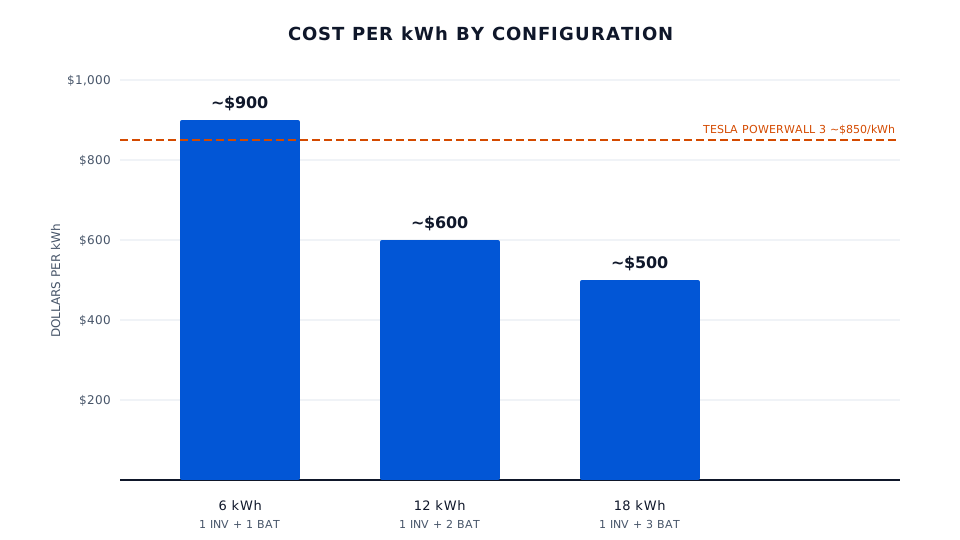
The Delta Pro Ultra is modular, which means the price depends on how big you build it. Here’s the breakdown as of early 2026:
| Configuration | Approximate cost | Cost per kWh |
|---|---|---|
| 1 inverter + 1 battery (6kWh) | $5,000-$5,800 | ~$830-$970/kWh |
| 1 inverter + 2 batteries (12kWh) | $6,500-$8,000 | ~$540-$670/kWh |
| 1 inverter + 3 batteries (18kWh) | $8,000-$10,000 | ~$440-$560/kWh |
| Smart Home Panel 2 | $1,500-$2,000 | — |
| Installation (licensed electrician) | $1,000-$2,500 | — |
The per-kWh cost drops hard as you add batteries. At 6kWh, it’s expensive. At 18kWh, it’s competitive with or cheaper than a Tesla Powerwall 3 on a per-kWh basis.
The sweet spot for most homeowners is 12-18kWh (two to three batteries), which runs $8,000-$12,000 before installation and the Smart Home Panel 2.
Total installed cost for a typical 12kWh system with Smart Home Panel 2: $10,000-$13,000.
If you installed a qualifying battery system before January 1, 2026, the 30% Residential Clean Energy Credit (Section 25D) applied — and on a $12,000 system, that was $3,600 back on your taxes. That credit no longer exists. The One Big Beautiful Bill Act, signed July 4, 2025, terminated Section 25D for all expenditures after December 31, 2025. If you’re installing in 2026 or later, there is no federal tax credit for residential battery storage. Check your state’s incentive programs — some states still offer rebates — but don’t factor a federal credit into your purchase math. Our battery storage tax credit guide covers what changed and what’s left.
How it stacks up against the competition
| Feature | EcoFlow Delta Pro Ultra | Tesla Powerwall 3 | FranklinWH aGate | Enphase IQ 5P |
|---|---|---|---|---|
| Base capacity | 6kWh | 13.5kWh | 13.6kWh | 5kWh |
| Max capacity | 90kWh | 54kWh (4 units) | 40.8kWh+ | 20kWh |
| Continuous output | 7.2kW | 11.5kW | 10kW | 3.84kW |
| Chemistry | LFP | LFP | LFP | LFP |
| Grid charging | Yes | Yes | Yes | Limited |
| Circuit-level control | Yes (12 circuits) | No | Yes (via aGate) | No |
| Portability | Yes (before install) | No | No | No |
| Warranty | 5 years | 10 years | 12 years | 15 years |
Three things stand out.
Output power per dollar. The Delta Pro Ultra delivers 7.2kW continuous from a single $5,000 base unit. Getting 11.5kW from a Powerwall 3 costs $11,500. Per-watt output, EcoFlow wins.
Expandability ceiling. 90kWh maximum is absurd for residential use — most homes will never need it. But the modular path from 6kWh to 18kWh to 30kWh means you can grow the system as your needs change. Buy an EV, add a battery. Install a heat pump, add another. You don’t have to predict your future load perfectly at purchase time.
Warranty is the weak spot. Five years on the inverter is short. Tesla gives you 10. FranklinWH gives you 12. Enphase gives you 15. EcoFlow’s 3,500-cycle battery rating suggests the hardware will outlast the warranty, but if the inverter fails in year 6, you’re paying out of pocket. This is the single biggest argument against the Delta Pro Ultra for permanent installation.
The real problems
The hardware is solid. The software needs work.
The app is inconsistent. Connectivity drops, especially over Wi-Fi at distance. The state-of-charge graph is missing from the analytics view where you’d expect it. Basic monitoring works, but the experience is a step behind Tesla’s app and two steps behind FranklinWH’s interface.
Firmware updates are annoying. Users on the DIY Solar Power Forum report receiving repeated firmware update notifications even when already running the latest version. Some updates have introduced new bugs. This is fixable with software maturity, but right now it’s a friction point.
Radio frequency interference. The inverter generates RFI even when not actively inverting. If you’re a ham radio operator or have sensitive RF equipment, this matters. For most homeowners, it doesn’t.
No generator passthrough during charging. If you plug a gas generator into the L14 port to recharge the batteries, the generator’s power routes through the inverter — it doesn’t pass directly to your loads. During the charging period, you’re still drawing from the battery while the battery charges from the generator. Not a dealbreaker, but it means charging from a generator is less efficient than you’d expect.
Documentation is thin. The official manual is a web-based guide that reads like it was translated from technical Chinese and then condensed. For a system that costs $10,000+ installed, the documentation should be better.
Who this is actually for
The Delta Pro Ultra is the right system if you want modular expansion without replacing hardware. Start with one inverter and one battery. Add batteries as your budget allows. Add a second inverter if you need more continuous output. No other system on the market offers this kind of incremental scaling.
It’s also the right system if you’re not ready to commit to a permanent installation on day one. You can buy the inverter and battery, use it as a standalone unit or connect it through an interlock kit, and add the Smart Home Panel 2 later when you’re ready for full integration.
It’s the wrong system if warranty length is your top priority. Five years on the inverter is a real limitation for a piece of equipment you’re bolting to your home. If 10-12 years of warranty coverage matters to you — and it should — look at Powerwall 3 or FranklinWH.
It’s also the wrong system if you already have Enphase solar. The Enphase ecosystem integrates with its own batteries far more cleanly than any third-party system.
Know your load before you buy anything. The size of system you need — in kWh capacity and kW output — depends entirely on what you’re powering and for how long. Start here: home generator sizing calculator.