Anker Solix F3800 home integration guide
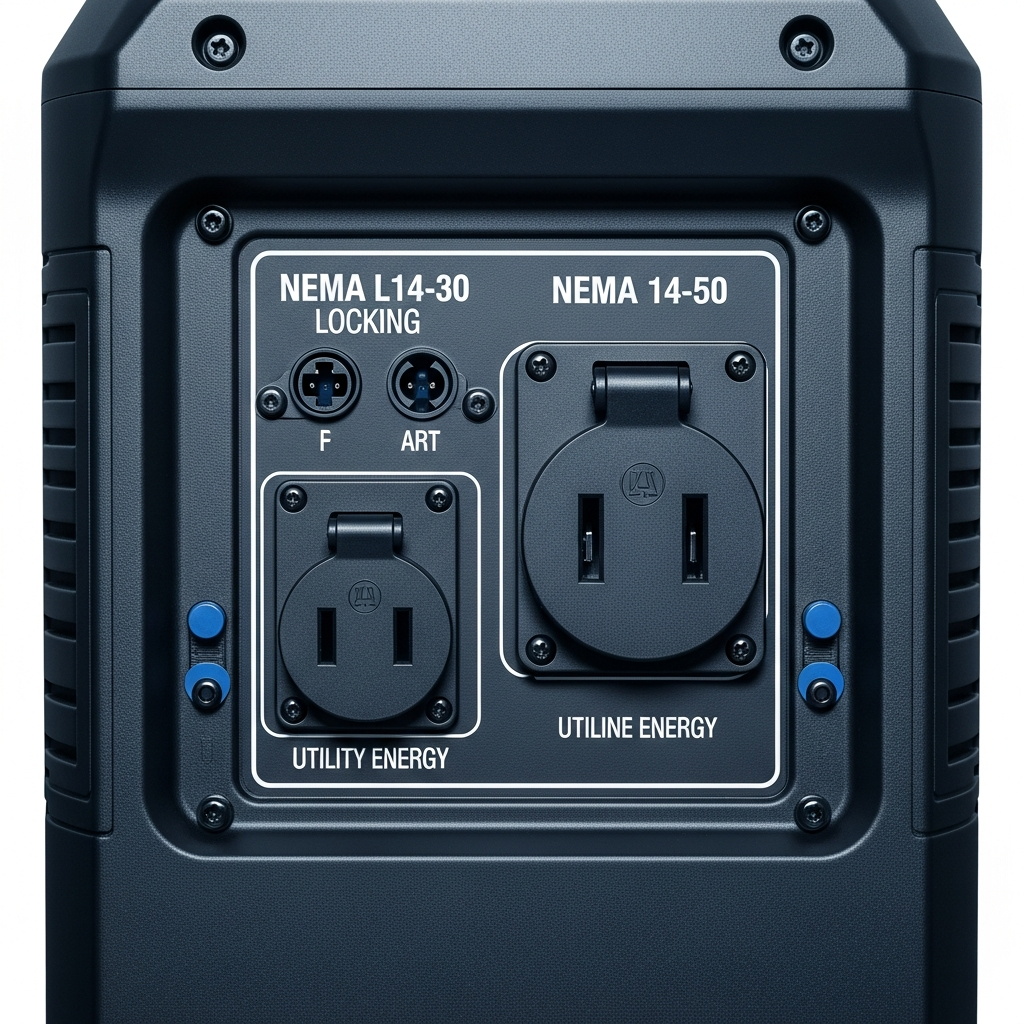
The Anker Solix F3800 is one of the few portable power stations that can legally tie into your home’s breaker panel and deliver 240V split-phase power. It has a built-in NEMA L14-30 outlet and a NEMA 14-50 outlet, which means your electrician already knows what cables to use. You don’t need a proprietary adapter or a custom wiring harness. You need a transfer switch, the right cord, and a licensed electrician who’s done this before.
This guide covers the three ways to connect an F3800 to your home panel, what each option costs, and the exact conversation to have with your electrician before anyone opens a breaker box. For the broader picture on how portable battery systems fit into home backup, start with our solar generator for home backup guide.
What makes the F3800 different from most portable units
Most portable power stations top out at 120V. They can run extension cords to individual appliances, but they can’t feed a breaker panel. Your breaker panel runs on 240V split-phase power, which is two 120V legs that work together to power your heavy loads — air conditioners, electric dryers, well pumps, electric ranges.
The F3800 outputs both. The NEMA 14-50 outlet delivers 240V at up to 50 amps. The L14-30 delivers 240V at 30 amps. That’s the same outlet configuration your electrician uses to wire a generator transfer switch. From the panel’s perspective, the F3800 looks like a generator.
Here are the numbers that matter for home integration:
| Spec | Value |
|---|---|
| Battery capacity | 3,840Wh (3.84kWh) |
| Continuous output | 6,000W |
| Surge output | 6,000W |
| 240V outlets | NEMA 14-50, NEMA L14-30 |
| 120V outlets | Six 20A standard outlets |
| Battery chemistry | LFP (LiFePO4) |
| Cycle life | 3,000+ cycles to 80% capacity |
| Solar input | 2,400W max |
| Weight | ~132 lbs |
| Expansion | One BP3800 battery adds 3,840Wh (7,680Wh total) |
The 6,000W continuous output is strong for a portable unit, but note the surge rating. Unlike gas generators that can briefly exceed their rated output, the F3800’s surge capacity matches its continuous rating. That means you need to pay attention to starting watts vs running watts for any motor loads. A 1-HP well pump that surges to 4,500W at startup will eat most of your available capacity for that fraction of a second.
Three ways to connect the F3800 to your panel
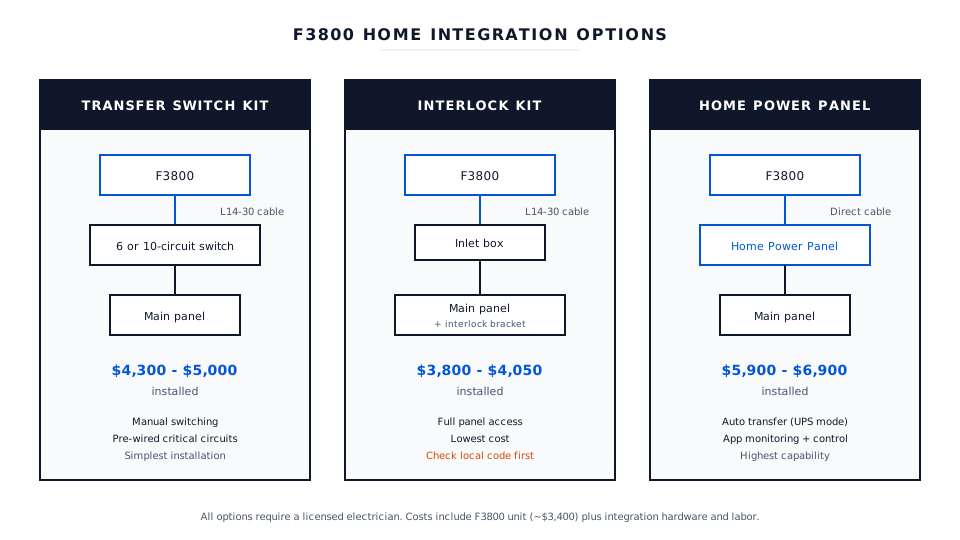
Option 1: Anker’s transfer switch kits ($400-$600)
Anker sells two transfer switch kits designed specifically for the F3800:
- Starter Home Backup Kit — 6-circuit, 30A, 120V/240V manual transfer switch with the cable included. Around $400.
- 10-Circuit Home Backup Kit — 10-circuit, 50A, 120V/240V manual transfer switch with cable. Around $600.
Both use Reliance Controls transfer switches (the Pro/Tran 2 series), which are the same switches electricians install for portable generators every day. Anker just bundles them with the correct cable for the F3800’s outlets. The 30A kit connects via the L14-30. The 50A kit connects via the NEMA 14-50.
These kits are the simplest path to home integration. Your electrician installs the transfer switch subpanel next to your main panel, wires your critical circuits into it, and mounts the inlet box on the exterior wall. When the power goes out, you wheel the F3800 to the inlet, plug in the cable, and flip the transfer switch to generator power. Same process as a gas generator.
Installation runs $500-$1,000 in electrician labor depending on how far the transfer switch is from your main panel and how many circuits you’re moving. Total cost including the kit: $900-$1,600 installed.
Option 2: Third-party transfer switch or interlock kit ($200-$1,400)
The F3800 works with any standard transfer switch or interlock kit that accepts an L14-30 or NEMA 14-50 input. You’re not locked into Anker’s accessories. Users on DIY Solar Power Forum have confirmed the F3800 works with Reliance Pro/Tran 2 switches purchased independently, and there’s no technical reason it wouldn’t work with a Generac, Briggs & Stratton, or any other brand.
If your local AHJ (Authority Having Jurisdiction) allows interlock kits, that’s your cheapest route: $200-$450 installed. The interlock physically prevents your main breaker and generator breaker from being on simultaneously. You get access to every circuit in your panel, not just the 6 or 10 that a subpanel transfer switch covers.
The catch: check that your interlock kit is rated for the amperage you’re pulling through the F3800’s outlet. A 30A interlock paired with the L14-30 connection limits you to 30A at 240V, which is 7,200W — well above the F3800’s 6,000W output, so that’s fine. A 50A interlock paired with the NEMA 14-50 is also fine.
Read our full transfer switch for generator guide before picking an option. Your local code determines which types are legal in your area.
Option 3: Anker Home Power Panel (~$2,000 + installation)
The Home Power Panel is Anker’s smart panel solution. It installs between your main breaker panel and your critical circuits, similar to EcoFlow’s Smart Home Panel 2 or a SPAN panel. When the grid drops, it switches to battery power automatically. No manual switching, no running outside to plug in a cord.
The Home Power Panel adds app-based monitoring and circuit-level control. You can prioritize loads, track consumption in real time, and set schedules. It also enables the F3800 to function as a UPS with automatic transfer, which the manual transfer switch options can’t do.
The tradeoff is cost. The panel hardware runs around $2,000, and installation is more involved than a basic transfer switch — expect $500-$1,500 in electrician labor depending on your panel configuration. Total installed: $2,500-$3,500 for the panel alone, plus the F3800 itself.
This option makes the most sense if you’re committing the F3800 as a permanent home fixture rather than a portable unit you might take to a job site or campground. If portability matters, stick with the transfer switch kit.
What to tell your electrician
Walk into this conversation with a plan. Electricians charge by the hour, and an hour of “let me explain what a portable power station is” is an hour you’re paying for.
Tell them the power source. “I have a battery system with a NEMA L14-30 outlet that outputs 120/240V split-phase at up to 6,000 watts continuous. It functions identically to a portable generator for panel connection purposes.” That’s all they need to know to spec the transfer switch.
Tell them your critical loads. List the circuits you want backed up. At minimum: refrigerator, well pump (if you have one), heating/cooling system control circuit, a few lighting circuits, and your internet router. Run the numbers through our home generator sizing calculator first so you know the total draw.
Tell them the connection type. If you’ve decided on a manual transfer switch, tell them the amperage (30A or 50A) and whether you’re using Anker’s kit or want them to source the switch. If you want the Home Power Panel, tell them that up front — it’s a different scope of work.
Ask about the permit. Any transfer switch installation requires an electrical permit and inspection. If they tell you it doesn’t, find a different electrician.
Ask about your panel capacity. If your main panel is already at its limit — common in older homes with 100A or 150A service — adding a transfer switch may require a panel upgrade. That’s $2,000-$5,000 extra. Better to know before the electrician opens the panel.
The 3.84kWh capacity question
Here’s the honest math. The F3800’s 3.84kWh capacity is modest for whole-home backup. Running a refrigerator (150W), a few lights (200W), your internet gear (50W), and cycling a well pump (750W running) puts you around 1,100W average draw. At that load, the F3800 lasts about 3.5 hours.
That’s not nothing. A 3.5-hour outage is the most common type. SAIDI data from the EIA shows the average U.S. customer experiences about 5-8 hours of outages per year, typically in blocks of 1-4 hours. The F3800 handles the majority of real-world outage scenarios without breaking a sweat.
For longer outages, you have two options:
Add solar panels. The F3800 accepts up to 2,400W of solar input. A set of four 400W panels keeps the battery topped off during daylight hours, turning a 3.5-hour battery into an indefinite power source as long as the sun is out.
Add the BP3800 expansion battery. Another 3,840Wh for a total of 7,680Wh. At the same 1,100W average load, that’s 7 hours. With solar panels, you’re looking at multi-day capability.
The F3800’s capacity alone does not establish tax-credit eligibility. The federal Section 25D credit ended for expenditures made after December 31, 2025, so a new 2026 installation gets no new credit. For a past installation or unused 2025 carryforward, review the portable power station tax credit guide and IRS instructions.
How the F3800 compares for home integration
The F3800 isn’t the only portable-to-permanent option. Here’s how it stacks up:
| System | Capacity | Continuous output | Home integration | Price (unit only) |
|---|---|---|---|---|
| Anker Solix F3800 | 3.84kWh | 6,000W | Transfer switch or Home Power Panel | ~$3,400 |
| EcoFlow Delta Pro Ultra | 6kWh | 7,200W | Smart Home Panel 2 | ~$5,000 |
| Bluetti EP900 | 9.9kWh (w/ B500) | 9,000W | Home Integration Kit | ~$11,800 |
The Delta Pro Ultra beats the F3800 on every spec — more capacity, higher output, better surge handling. We covered it in depth in our EcoFlow Delta Pro Ultra review. But it also costs $1,600 more for the base unit, and EcoFlow’s Smart Home Panel 2 runs around $1,700. The total system cost gap widens fast.
The F3800’s advantage is entry price. An F3800 plus Anker’s 6-circuit transfer switch kit plus installation runs around $4,300-$5,000 total. An EcoFlow Delta Pro Ultra plus Smart Home Panel 2 plus installation starts around $8,000-$10,000. If your outage risk is moderate and your critical load is small, the F3800 does the job for roughly half the cost.
The Bluetti EP900 is a different category entirely. It’s a permanently installed home battery system that requires professional installation from the start. Higher capacity, higher output, but also $11,000+ before installation labor.
Motor loads and surge limitations
The F3800’s 6,000W surge rating is its biggest limitation for home backup. Gas generators often surge to 150-200% of their rated output for a few seconds. The F3800 doesn’t. 6,000W continuous is also 6,000W surge.
That means you need to manage motor startups carefully. If your refrigerator compressor (1,200W surge) and your well pump (4,500W surge) try to start at the same time, you’ll overdraw the inverter and it’ll shut down. With a transfer switch, you control this by bringing circuits online one at a time. With the Home Power Panel, the system manages load sequencing automatically.
A soft starter can solve the worst cases. A Micro-Air EasyStart on your well pump motor can cut the starting surge from 4,500W down to around 1,500W, leaving plenty of headroom for other loads. These run $300-$500 installed. If you have a well pump and you’re using the F3800 for backup, a soft starter isn’t optional — it’s part of the system cost.
For air conditioning, a 3-ton central AC compressor typically surges to 9,000-12,000W. The F3800 can’t handle that, period. A soft starter brings it down to 2,000-3,000W, which is within range but leaves almost no headroom for other loads. If central AC during outages is a requirement, the F3800 isn’t enough. Look at the EcoFlow Delta Pro Ultra or a dedicated home battery system from our best whole house battery backup guide.
Cost breakdown
Here’s what a complete F3800 home integration actually costs, from the cheapest option to the most capable:
| Configuration | Hardware | Installation | Total |
|---|---|---|---|
| F3800 + interlock kit | ~$3,600 | $200-$450 | $3,800-$4,050 |
| F3800 + 6-circuit transfer switch kit | ~$3,800 | $500-$1,000 | $4,300-$4,800 |
| F3800 + 10-circuit transfer switch kit | ~$4,000 | $500-$1,000 | $4,500-$5,000 |
| F3800 + Home Power Panel | ~$5,400 | $500-$1,500 | $5,900-$6,900 |
| F3800 + expansion battery + 10-circuit kit | ~$6,500 | $500-$1,000 | $7,000-$7,500 |
Do not subtract a 30% federal credit from these figures for a new 2026 installation. Compare the full hardware and installation quote. A qualifying historical installation and an unused-credit carryforward require separate tax-year review; neither makes a new purchase eligible.
Know your load before you buy anything. The size of system you need depends on what you’re powering and for how long. Plug your appliance list into our home generator sizing calculator and bring those numbers to your electrician.