Solar generator for home backup integration
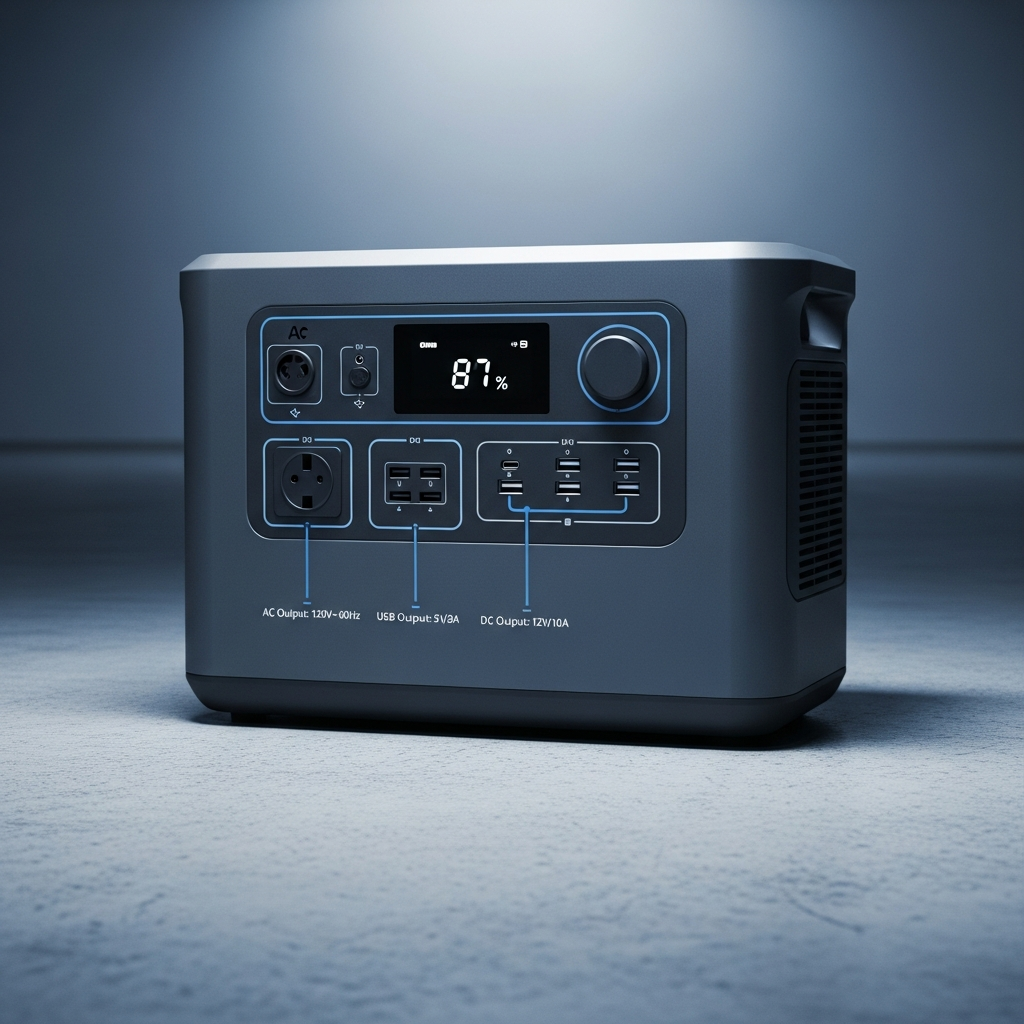
After a week-long outage a few years back, I spent $1,400 on a portable power station that I thought would run my well pump. It didn’t. The pump needed 240V split-phase power. My shiny new battery box output 120V only. I had a $1,400 paperweight and no running water for five days.
That’s the education that prompted this site. And it’s why the first thing you need to understand about solar generators isn’t which brand to buy — it’s what they actually are, what they cannot do, and how to connect them to your home without killing yourself or a utility worker.
Before we get into specs and sizing, read this: the only safe, legal way to connect any portable power source to your home’s electrical system is through a transfer switch or an interlock kit with a generator inlet box. That’s it. There is no other method. Anyone who tells you otherwise is wrong.
What a “solar generator” actually is
Marketing has done a lot of damage here. A “solar generator” is not a generator. It produces no electricity from combustion, has no fuel tank, and doesn’t run on gasoline, propane, or natural gas. What you’re actually buying is a portable battery pack with four components integrated into one box:
- A lithium battery bank (measured in watt-hours, typically 1,000 to 5,000+ Wh)
- A charge controller (manages input from solar panels, AC wall outlet, or car port)
- An inverter (converts DC battery power to AC household power)
- An outlet panel (USB-A, USB-C, AC outlets, and sometimes a 30-amp or 50-amp port)
These are sometimes called “portable power stations” or PPSs. EcoFlow, Bluetti, Jackery, Anker Solix, and Goal Zero all make them. They’re genuinely useful devices. But they’re not generators, and that distinction matters when you’re figuring out whether one will power your home during an outage.
No exhaust means you can run them indoors — which is one real advantage over gas generators. No fuel storage, no carbon monoxide risk.
The 240V problem
Here’s the single spec that will determine whether a portable power station is useful to you during an outage: does it output 240V?
Most homes in the US run major appliances on 240V split-phase circuits. Your central air conditioner, electric water heater, electric dryer, electric range, and well pump almost certainly run on 240V. These appliances need two “legs” of 120V power combined to produce 240V — and most portable power stations cannot do this.
The overwhelming majority of units on the market — including most of the popular ones you’ll see reviewed on YouTube — output 120V only. That means:
- You cannot run a central AC unit
- You cannot run an electric dryer
- You cannot run a standard electric water heater
- A well pump on a 240V circuit will not start
This isn’t a software limitation or a firmware update away from being fixed. It’s a hardware constraint. A 120V-only inverter is a 120V-only inverter.
Units that can output 240V:
- EcoFlow Delta Pro Ultra with Hub — the Hub combines two Delta Pro Ultras to produce split-phase 240V, up to 7,200W continuous
- Bluetti EP900 — designed for home integration, 240V output via included wiring, 9,600W continuous
- Anker Solix F3800 with Home Power Panel — 6,000W continuous, 240V output with the optional panel accessory
These units also cost $3,500 to $8,000+. And you still need a proper electrical connection to your panel.
Units that are 120V only (but widely marketed for home backup):
Standard EcoFlow Delta Pro (single unit), Bluetti AC300, Jackery Explorer 2000 Pro, Goal Zero Yeti 3000X, and essentially any unit priced below $3,000. Fine for essential loads on 120V circuits. Not fine if you need your well pump or AC.
How to legally connect a portable unit to your home
A portable power station has AC outlets on its face, just like a wall outlet. The wrong assumption is that you can run an extension cord from those outlets to your house and call it done. You can’t. Not legally, not safely.
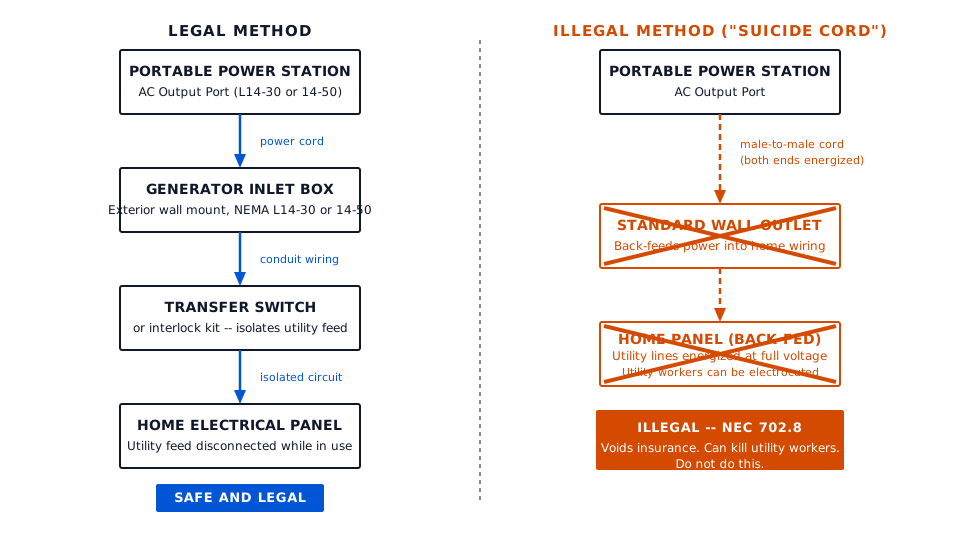
The legal method is a dedicated generator inlet box wired to a transfer switch or interlock kit on your panel. The setup looks like this:
- An inlet box is mounted on the exterior of your house (weatherproof, male NEMA L14-30 or 14-50 receptacle facing out)
- Inside, the inlet box is wired to your main electrical panel
- A transfer switch or interlock kit ensures that when generator power is active, the utility feed is physically disconnected
- You run a cord from the power station’s AC output to the inlet box
The inlet box outside accepts a cord from your power station. The transfer switch inside ensures you’re never simultaneously connected to utility power and your generator. Your electrician handles the wiring — this is not a DIY project unless you’re a licensed electrician.
The cost for this setup runs $300 to $800 in parts plus electrician labor. It’s not optional. It’s the price of doing this safely.
The suicide cord: why it kills people
I’m going to be direct about this because the mainstream generator internet is not, and people die because of it.
A suicide cord is a male-to-male extension cord. Both ends have prongs that stick out. One end plugs into a household outlet on your wall; the other end plugs into the power station’s AC output. The idea is to “back-feed” power from the generator into the house through the outlet.
This kills people. Here’s why.
When you back-feed power into a circuit through a wall outlet, that power travels backward through the wiring in your walls, through the breaker panel, and out to the utility lines. The transformer on the pole steps the voltage up from 120V household to thousands of volts on the distribution line.
Utility workers responding to the outage do not know your panel is energized. They grab what they believe is a dead line. They die.
For you: a male-to-male cord with both ends energized is called a “hot dog.” If either end comes loose while plugged in, you have live 120V prongs waving around. Touch them and you’re the circuit.
This method is illegal under the National Electrical Code (NEC 702.8). It voids your homeowner’s insurance. If a utility worker is injured, you are liable. Do not do this. Don’t let anyone do it in your presence.
Get the inlet box. Hire the electrician. The transfer switch isn’t optional safety theater — it’s what keeps the power where it belongs.
Sizing solar panels to recharge during an outage
A portable power station is a battery. Batteries run out. During an extended outage, your ability to recharge from solar panels is what determines whether this investment actually works.
Here’s the math. Say you have a 10 kWh (10,000 Wh) battery bank and you use 5 kWh overnight running a refrigerator, LED lights, phone charging, and a CPAP machine. You need to replace 5 kWh during daylight hours.
At 400W per panel (a common modern panel size), in 5 hours of peak solar production, one panel generates 2 kWh. To generate 5 kWh, you need 2.5 panels worth of output — call it 3 panels under ideal conditions.
But conditions are rarely ideal. A partly cloudy day might cut production by 40 to 60%. East or west-facing panels instead of south-facing lose 20 to 30%. A dirty panel surface costs you another 10 to 15%.
For realistic planning in the continental US, budget for 4 to 6 hours of effective full-power production per day under outage conditions, and assume you’ll need 4 to 6 panels (1,600W to 2,400W of array) to reliably replace 5 kWh per day. With a 10 kWh battery running essential-only loads and 6 panels, you can sustain yourself through a multi-day outage with sun.
The solar charging rate also matters. A 2,000W-capable power station will only accept as much solar as its charge controller can handle — most units cap input between 500W and 2,400W. Check your unit’s maximum solar input spec before buying panels.
Where a solar generator actually makes sense
These units shine in specific scenarios. If your situation matches one of these, a portable power station is probably the right tool.
24 to 72-hour outages with reasonable sun. The most common outage duration in the US is under 4 hours. The next most common is 4 to 24 hours. A 2,000 to 5,000 Wh power station covers the vast majority of real-world outages for essential loads.
Essential load coverage only. Refrigerator (150W running), LED lighting (50W), phone and laptop charging (100W), CPAP or nebulizer (50 to 150W) — this is a 350 to 550W continuous draw. A 2,000 Wh battery gives you 3.5 to 5.5 hours of runtime on essentials without any recharge. With solar input, you can sustain this load indefinitely.
Situations where a gas generator is off the table. HOA rules often prohibit gas generators. Renters can’t install a standby system. Some people don’t want to store fuel. If you have a medical device that can’t be interrupted, a lithium battery system with solar is cleaner and more reliable than fighting with a pull-start gas unit at 2 AM.
Well-pump exception: if you have a 240V submersible well pump and your portable power station is 120V-only, plan for stored water instead. A 55-gallon emergency water container costs $40. Fill it before the storm.
Where a solar generator falls short
Be honest with yourself about these limitations before spending $2,000.
No sun for multiple days in a row is a problem. Three days of overcast skies with no grid and a depleted battery means no power. A gas or propane standby generator doesn’t care about cloud cover.
Central AC is usually out of reach. Even units with 240V output are typically rated at 3,000 to 7,200 watts — a 3-ton central AC draws 3,500W running and surges to 9,000W or more at startup. Check the starting watts vs running watts numbers on your AC unit before assuming any portable unit can start it. Most can’t.
An electric water heater draws 4,500 watts continuous. On a 10 kWh battery, that’s 2.2 hours of hot water and a dead battery. If you have an electric water heater, plan to go without hot water during an outage, or switch to a heat pump water heater that draws 500W.
Whole-home backup at any meaningful scale requires a different solution. If you need your HVAC, water heater, range, dryer, and all your 240V loads covered automatically for days at a time, a portable power station isn’t the right tool. A whole-home standby generator, or a large whole-home battery system like a Powerwall or Powerwall 3, is the actual answer. A portable unit can supplement these — it can’t replace them.
Before you connect anything, talk to an electrician
I’ll say this once clearly: hire a licensed electrician to install the inlet box and transfer switch or interlock kit. Call it $600 to $1,200 all-in depending on your panel’s location and local labor rates.
This is not optional. It’s the difference between a system that works legally and safely, and one that could kill a utility worker, burn your house down, or get your insurance claim denied. Use our home generator sizing calculator to figure out what loads you actually need to cover, then bring that load list to an electrician and have the conversation about the right inlet and switching hardware for your setup.
If you want to go bigger — whole-home coverage, automatic switchover, multi-day capacity — the next step is understanding standby generators and permanent battery systems. Start with our home generator sizing calculator to know exactly how much power you actually need.