SGIP rebate California battery guide
If you are shopping for a California battery rebate in 2026, here is the short answer: the broad SGIP rebate most homeowners have heard about is over for new applications. The 2026 SGIP Handbook says the old ratepayer-funded SGIP budgets stopped taking new applications after December 30, 2025. The live path now is the low-income Residential Solar and Storage Equity (RSSE) program created by AB 209, and it is a much narrower target.
That one fact changes the whole conversation. Plenty of sales pages still talk about SGIP like it is a coupon code any California homeowner can stack onto a battery quote. That was close enough in 2025. It is not true on May 18, 2026. If you need the wider incentive picture, read the battery storage tax credit guide first. This article is about what SGIP actually looks like right now.
The old SGIP and the 2026 SGIP are not the same thing
When homeowners say “SGIP,” they usually mean the old Self-Generation Incentive Program that paid battery rebates across general-market, equity, and equity resiliency buckets. That version is the one installers used in glossy “battery for half price” ads.
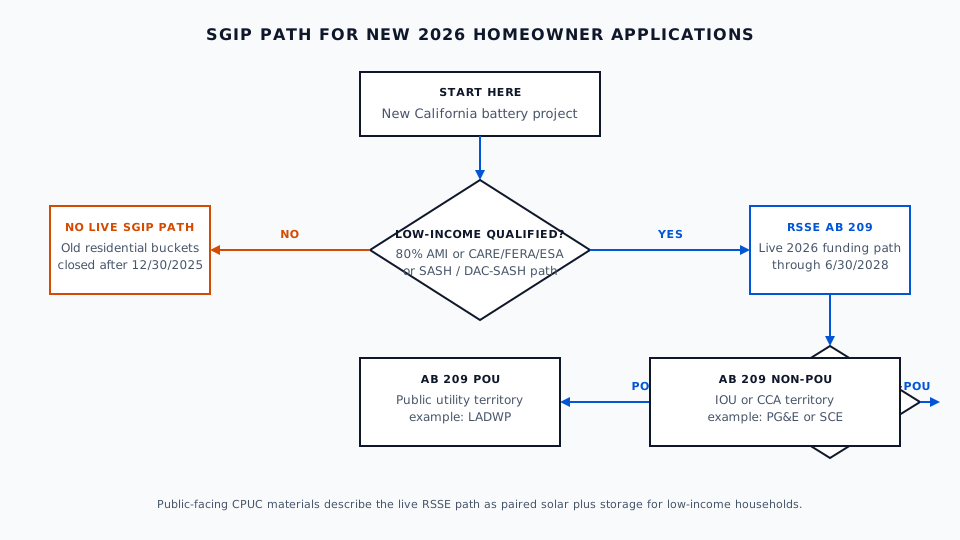
The current program is different. Per the January 21, 2026 program announcement, all new residential applications now flow through the AB 209 budgets, which stay open through June 30, 2028. The CPUC’s RSSE fact sheet describes that money as support for paired solar and storage at low-income residential properties.
That means two things in plain English:
- If you are a normal market-rate homeowner starting from scratch in 2026, SGIP is probably not your rebate anymore.
- If you do qualify, you are applying through an equity program with tighter rules, not the old broad homeowner bucket.
Who still qualifies in 2026
For the single-family homeowner audience ShelterVolt is written for, the low-income screen is the whole game. The CPUC fact sheet lists six main ways to qualify: household income at or below 80% of area median income, or enrollment in CARE, FERA, ESA, SASH, or DAC-SASH.
The other catch is the project structure. Public-facing CPUC materials describe the live RSSE program as solar plus storage, not a generic battery-only rebate. If you already have solar on the roof and want to add storage, ask the Program Administrator whether your existing system satisfies the pairing requirement before you sign anything. Do not assume a battery-only backup project qualifies just because a salesperson says “it’s still SGIP.”
POU language trips people up too. It just means publicly owned utility territory, like LADWP. Non-POU is everybody else in the investor-owned or community-choice world. Your installer should be able to tell you which budget bucket they are filing under without mumbling through it.
What the current rebate can actually pay
The live AB 209 rates are generous. Very generous. The 2026 SGIP Handbook sets residential solar at $3.10 per watt and storage at $1.10 per watt-hour for AB 209, AB 209 POU, and AB 209 Non-POU.
Run the math on a common backup setup:
- 13.5 kWh battery x $1.10/Wh = $14,850
- 5 kW of solar x $3.10/W = $15,500
- Combined theoretical incentive = $30,350
Now the reality check. That does not mean every qualified homeowner gets a free battery and free solar. The same handbook caps single-family projects at 15 kWh of storage and 5 kW of solar before extra load justification kicks in, with an absolute storage cap of 30 kWh. It also cuts the storage incentive in half for systems with discharge duration over four hours and to zero above six hours. The program is trying to buy resilience, not reward oversized spec-sheet theater.
There is also a total-cost guardrail. The LADWP SGIP update page notes that, as of March 6, 2026, RSSE projects with total eligible project costs below 90% of the maximum incentive have to provide extra cost verification. In normal language: if an installer inflates the quote to soak up every possible rebate dollar, the administrator can push back.
That is why I would treat any “free battery” pitch with suspicion until I saw the line-item contract.
The waitlist answer is: it depends on your territory
There is no honest statewide answer to “How long is the SGIP waitlist?” The only good answer is to check the public SGIP metrics page for the exact budget your developer plans to use.
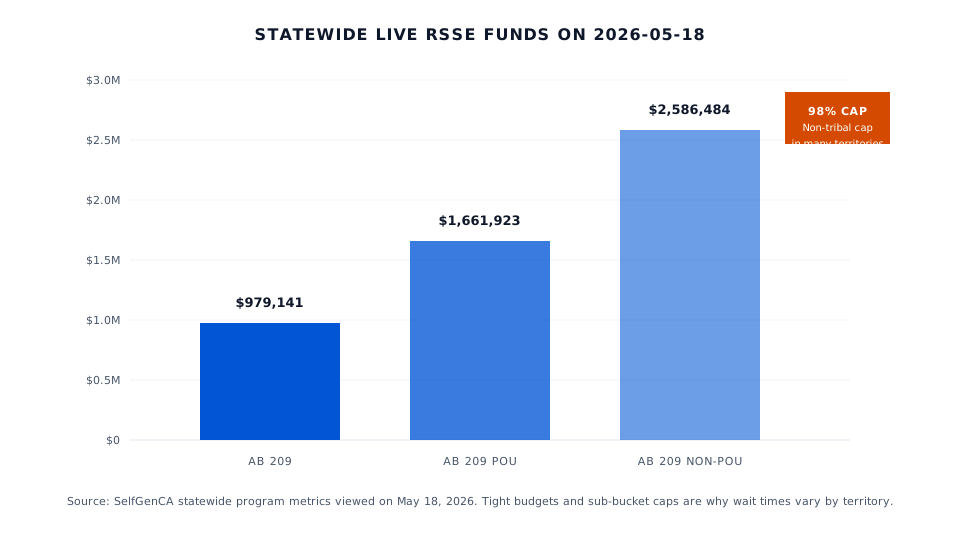
As of May 18, 2026, that statewide page showed:
- $979,141 available in AB 209
- $1,661,923 available in AB 209 POU
- $2,586,484 available in AB 209 Non-POU
That sounds like a lot until you remember the example project above can chew through roughly $30,000 of incentive value. The same page also showed the non-tribal caps sitting at 98% in CSE, SoCalGas, LADWP, SCE, and PG&E territory buckets. In other words: this is not sleepy leftover funding. It is active, tight, and territory-specific.
If an installer tells you “the waitlist is about six months” without naming the exact budget bucket, they are guessing. Make them send you the public metrics link and show you the bucket name on the same day they ask for a deposit.
How to apply without getting jerked around
Here is the practical checklist I would use before signing anything:
- Confirm the household qualifies on income or utility-program enrollment. Get that squared away first.
- Ask whether the project is being filed under AB 209, AB 209 POU, or AB 209 Non-POU. If they cannot answer that clearly, keep shopping.
- Ask whether the quote assumes paired solar and storage, or whether it is counting an existing solar array toward the requirement.
- Ask for the proposed battery size in kWh and the discharge duration. A huge kWh number with low power can trip the duration haircut.
- Ask whether the total eligible project costs are high enough to avoid the new cost-verification problem.
- Save every document: income qualification, utility enrollment proof, line-item quote, permit record, and final inspection.
The mistake I would avoid is letting the rebate drive you into a bad system design. A cheap-feeling battery that qualifies for a program is still the wrong battery if it cannot start your well pump, run your blower motor, or ride through the outage window you actually care about.
My blunt take
SGIP is still real money. But for new 2026 residential projects, it is no longer broad California battery money. It is targeted low-income resilience money with paired solar-and-storage rules, shrinking territory budgets, and a lot more paperwork than the ads suggest.
That does not make it bad. It makes it specific. If you fit the box, move fast and keep your paperwork clean. If you do not fit the box, stop budgeting around SGIP and make the battery purchase stand on its own numbers.
If you do qualify, shortlist the hardware first with best whole house battery backup systems, then run your actual loads through the home generator sizing calculator. A rebate is nice. A correctly sized backup system is nicer.