What size battery to backup a house for 3 days?
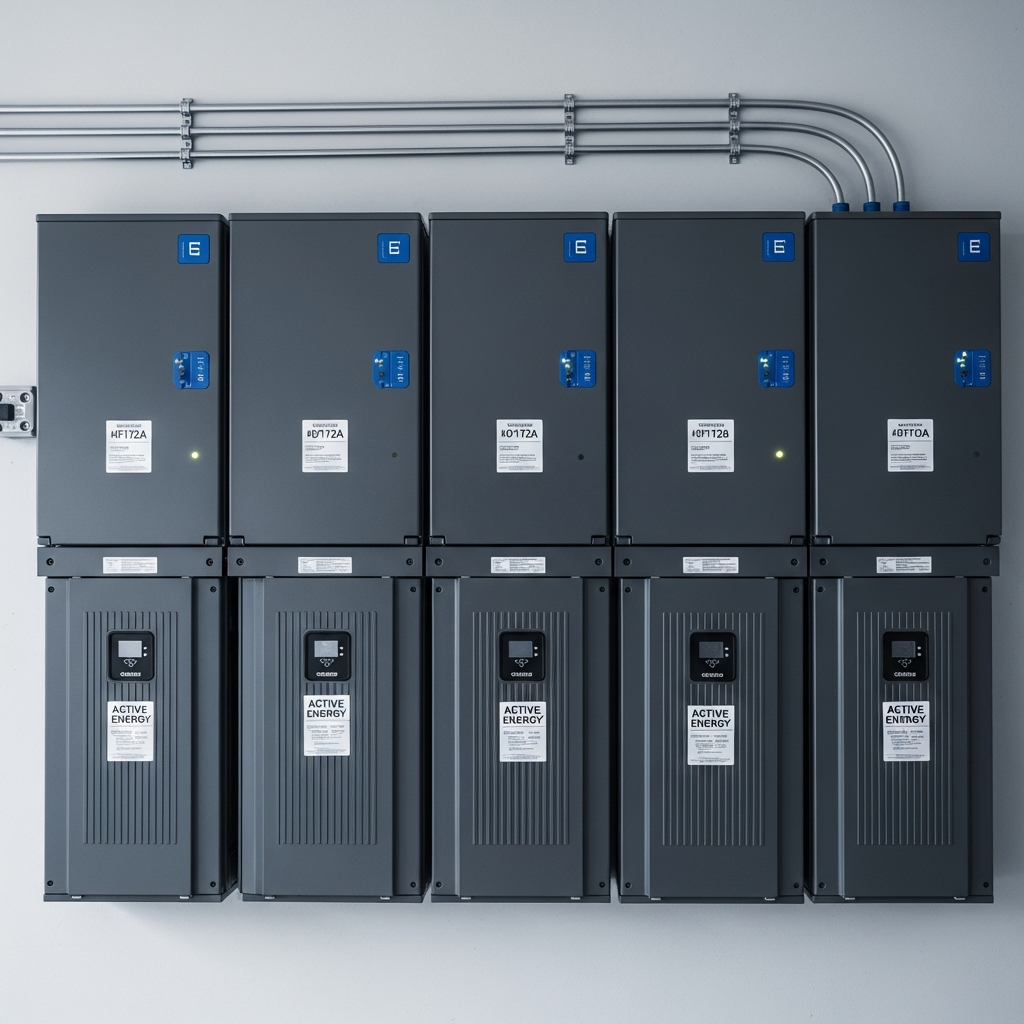
Backing up a house for three full days on battery alone requires between 40 and 90 kilowatt-hours of storage depending on what you’re running. At current hardware prices, that’s $35,000 to $80,000 before installation. For most homeowners, that math points directly at a generator.
That’s not an anti-battery take. It’s the arithmetic. If you want to understand where the numbers come from — and when batteries actually win — keep reading. If you’ve already read how long will a 10kWh battery run a house, you’ll recognize the three load profiles below. This article extends that math across 72 hours.
The baseline: what three days actually costs
A single Tesla Powerwall 3 holds 13.5kWh and retails around $11,500. To back up even a modestly disciplined household for three days, you need multiple units. That’s the reality the marketing avoids.
Here’s the math at three real-world load levels.
Load profile 1: Survival mode
What you’re running: Refrigerator, LED lighting, phone and laptop charging, CPAP if needed, well pump on demand. No heating, no air conditioning, no water heater.
Average draw: 400 to 500 watts Daily consumption: ~12kWh/day Three-day total: ~36kWh
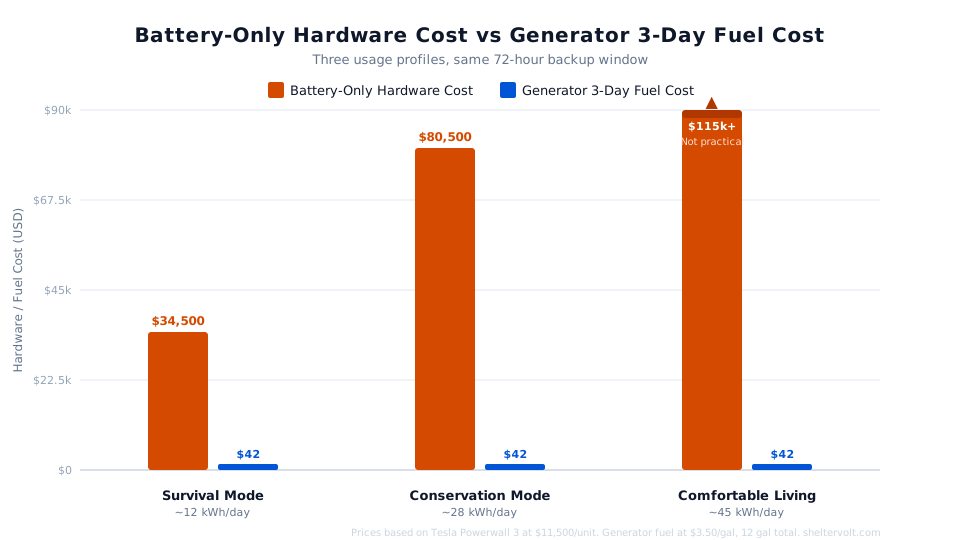
What it takes: Three Tesla Powerwall 3 units give you 40.5kWh of capacity — enough to cover three days of survival-mode loads with a small buffer. Hardware cost at current pricing: approximately $34,500. That does not include installation, which typically runs $3,000 to $8,000 depending on your electrical panel and whether a transfer switch or whole-home gateway is required.
Survival mode is actually achievable with current residential battery hardware. Three Powerwalls is a lot, but it’s within the range of what can be physically installed in a standard home.
Load profile 2: Conservation mode
What you’re running: Everything from survival mode, plus one window AC unit, a TV, and laptop and phone charging across a household.
Average draw: 900 to 1,100 watts Daily consumption: ~28kWh/day Three-day total: ~84kWh
What it takes: Seven Powerwall 3 units to cover 94.5kWh. Hardware cost: approximately $80,500. Installation on a system this size typically runs $6,000 to $12,000, requiring a full home energy management gateway, load center, and potentially a panel upgrade.
This is where the math gets uncomfortable fast. $80,000 in battery hardware to watch TV and run one window unit for three days is hard to justify outside of very specific circumstances.
Load profile 3: Comfortable living
What you’re running: Conservation mode loads plus an electric water heater cycling periodically and occasional cooking on an electric range.
Average draw: 1,800 to 2,000 watts Daily consumption: ~45kWh/day Three-day total: ~135kWh
This scenario is simply not practical with current residential battery systems. The hardware doesn’t exist in a configuration most homeowners can install — Tesla limits residential Powerwall stacking, and 135kWh would require around ten units plus custom engineering. It also doesn’t make economic sense. At $11,500 per unit, you’re north of $115,000 in hardware alone.
If comfortable living is the goal for a multi-day outage, a standby generator is the answer. Full stop.
Why solar recharge changes the equation
The three-day battery math above assumes zero recharging during the outage. That’s the realistic scenario for a grid failure without solar: the battery is whatever was in it when the lights went out, and nothing is adding to it.
Add a solar array and the math inverts entirely.
A 4kW solar array in a region with five peak sun hours per day generates 20kWh per day. That’s enough to fully offset survival mode consumption. You’re not drawing down a fixed reserve — you’re running a real-time energy balance. Sunny days, you break even or bank a small surplus. Cloudy days, you draw down the battery and hope for tomorrow’s sun.
Practical upshot: a 20kWh battery system paired with a 4kW solar array can sustain survival mode indefinitely under normal weather conditions. For conservation mode — around 28kWh/day — a 40kWh battery with the same 4kW array maintains a daily deficit of about 8kWh on a sunny day. You’d slowly draw down the battery over a week without additional sun. Bump the solar to 6kW (30kWh/day in good sun) and conservation mode becomes sustainable.
If you have solar, the three-day question looks very different. You’re not sizing for 72 hours of storage — you’re sizing for overnight storage and cloudy-day reserves. That’s typically 20 to 40kWh, which is a real and purchasable amount of hardware.
Without solar, you’re sizing for a fixed tank. And for multi-day outages, that tank gets expensive fast.
The generator comparison
A 7,500W portable generator at 50 percent load burns approximately 0.5 gallons of gasoline per hour.
Run it eight hours per day for three days: 24 hours of runtime, 12 gallons of gas, at $3.50 per gallon.
Three-day cost: $42.
Compare that to the survival-mode battery scenario: $34,500 in hardware to accomplish roughly the same thing. Even if you amortize that battery cost over ten years of expected cycle life (3,650 charge cycles for LFP chemistry), you’re still paying nearly $10 per day for the privilege of generator-free power. The generator costs $0.175 per day in fuel for the same scenario.
For whole-home standby coverage, check the Generac 22kW fuel consumption numbers — natural gas or propane standby units are even cheaper to operate per hour than portable generators on gasoline, though they come with installation costs.
The generator math wins decisively for multi-day outages without solar recharge. This isn’t close.
When battery makes sense
The battery math isn’t always a loss. There are scenarios where batteries are the right tool.
Outages under 24 hours. This is the sweet spot for residential battery storage. Most grid outages are restored within a few hours. A 10 to 20kWh battery covers a typical overnight outage in conservation mode without you ever starting a generator. No fuel to store, no exhaust, no noise complaints at 2am.
Homes with solar arrays. As described above, battery + solar is a fundamentally different equation. The battery becomes daily overnight storage, not a multi-day tank. The sizing math is more manageable, and the economics work.
HOA restrictions on generators. Some HOAs prohibit portable generators. In that case, battery storage is the only available backup option, cost notwithstanding.
Medical equipment requiring clean power. Generators produce power with frequency and voltage variation that can affect sensitive equipment. Battery inverter output is cleaner. If someone in your household runs a medical device that requires stable power, battery storage has a real functional advantage.
Frequent short outages. In areas where the grid is unreliable but outages rarely exceed a few hours, the economics of battery storage look different. You might use the system 30 or 40 times per year instead of twice. Over ten years, that changes the amortization math.
When generator wins
Multi-day outages with no solar recharge. The fuel cost is negligible compared to the hardware cost of equivalent battery capacity.
Whole-home backup including large loads. Central AC, electric water heaters, and electric ranges are simply not practical to back up with batteries at multi-day timescales. A 10,000-watt standby generator handles these loads without breaking a sweat.
Rural properties with well pumps and agricultural loads. The starting surge requirements and raw wattage needs of rural properties favor generator capacity over battery capacity. Use a home generator sizing calculator to establish your minimum wattage before pricing either option.
Homes where upfront cost is prohibitive. A quality portable generator costs $800 to $1,500. A quality entry-level battery system costs $12,000 to $20,000 installed. If capital is limited, the generator provides far more backup capacity per dollar.
The hybrid approach
Most homeowners who’ve thought through this land on the same answer: battery for the first 24 hours, generator for anything longer.
A 10 to 20kWh battery system handles overnight outages silently and automatically. It covers the medical equipment, the refrigerator, the lights, and enough HVAC to stay comfortable through a single summer night. When an outage extends past 24 hours, you start the generator. For the extended stuff — the days-long ice storm, the post-hurricane week without power — the generator takes over.
This combination is typically cheaper than either pure approach. A 20kWh battery system installed costs roughly $25,000 to $30,000. Add a $1,200 portable generator and $500 in fuel storage infrastructure and you have a system that handles 95 percent of real-world outage scenarios for less than the cost of a battery-only survival-mode setup.
The whole house battery backup systems guide covers the hardware options for the battery side of this hybrid. For the generator side, a proper load calculation is where to start.
What the next five years look like
Battery prices have dropped roughly 15 to 20 percent per year as manufacturing capacity scales. The math that makes battery-only three-day backup impractical today will look different in five years.
A 40kWh system that costs $46,000 in hardware today might cost $20,000 to $25,000 by 2030. That changes the break-even against generators in some scenarios. It doesn’t change the generator math for people who need a solution now — but if you’re doing long-range planning and already have or plan to install solar, designing your electrical system for battery expansion makes sense. The conduit runs and panel upgrades you do today are the same ones you’d need for a much larger system in five years.
If battery is your long-term direction, install the infrastructure for a larger system even if you only populate it with two or three units initially.
The most cost-effective answer for most homeowners is a hybrid system — battery for the first 24 hours, generator for the rest. Start by calculating your actual load: home generator sizing calculator.