Inverter generator vs standard generator for home backup
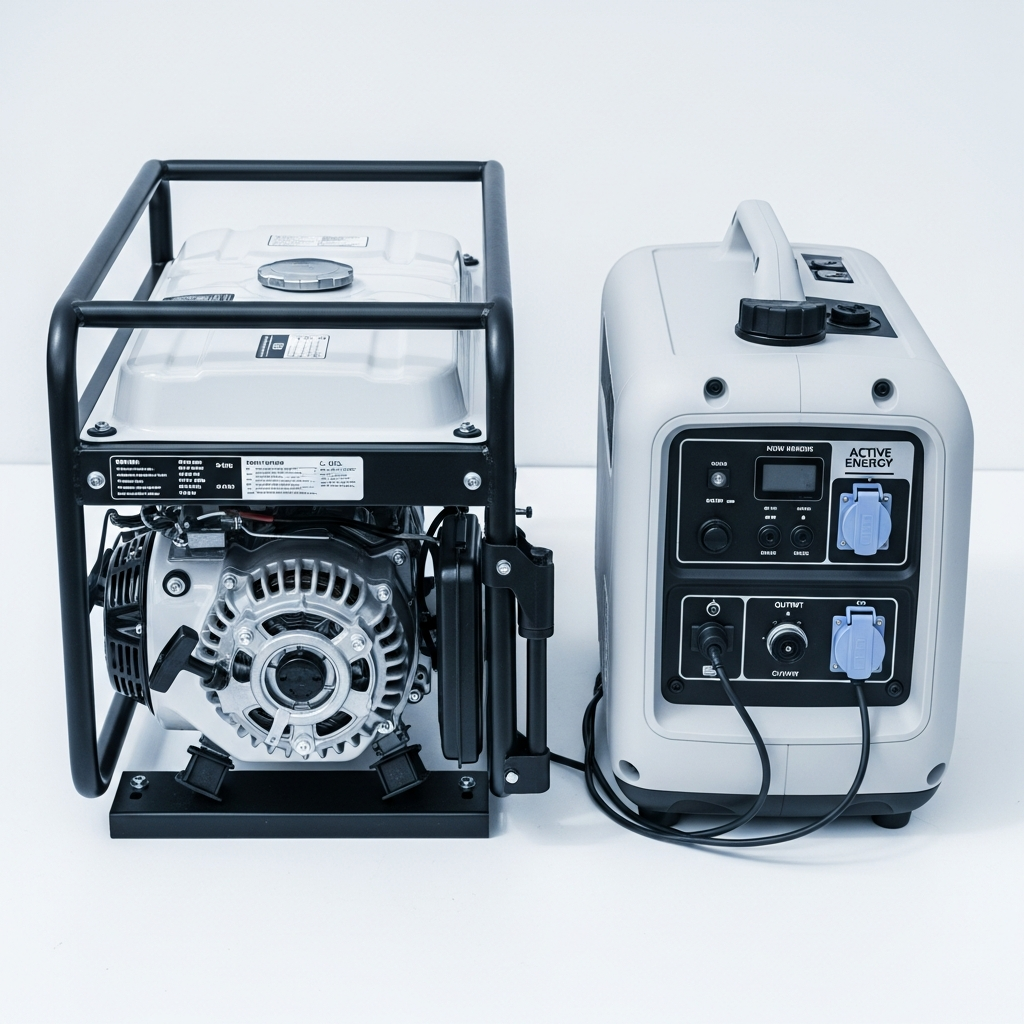
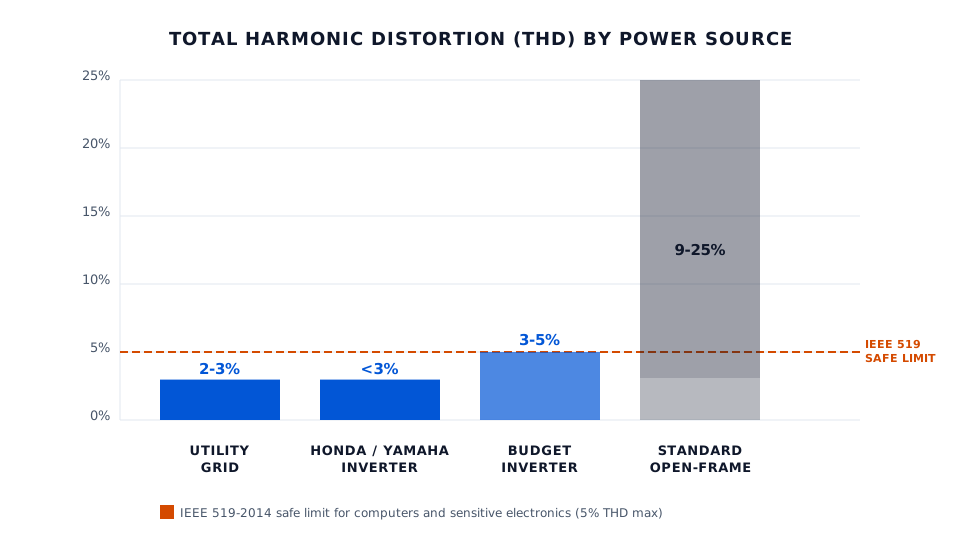
A standard open-frame generator can fry your smart fridge, your flat-screen TV, and your gaming console. An inverter generator won’t. The difference comes down to one spec most people never check: total harmonic distortion, or THD. Standard generators produce power with THD between 9% and 25%. Inverter generators sit under 5%, with Honda units under 3%. IEEE Standard 519-2014 says your computer needs power under 5% THD. Your standard generator doesn’t meet that threshold.
That’s the short answer. The rest of this article explains what THD actually is in plain English, why it matters for every appliance in your house that has a microprocessor in it, and whether the price premium on an inverter generator is worth paying.
Before you read further, make sure you understand how to safely connect any portable generator to your house. The cleanest power in the world won’t help if you backfeed your panel through a suicide cord.
What total harmonic distortion means (without the engineering degree)
Your utility company sends you electricity as a smooth, repeating wave — a sine wave. Every cycle is identical: a clean arc up, a clean arc down, 60 times per second. Your appliances are designed to run on that smooth wave.
A generator tries to replicate that wave. An inverter generator does it well. A standard generator does it badly.
Picture it like sound from a speaker. A pure tone — a single note on a tuning fork — is a clean sine wave. Now imagine that same note played through a blown speaker with a rattling cone. The fundamental pitch is still there, but there’s buzzing, crackling, extra frequencies layered on top. That’s harmonic distortion. The extra noise riding on top of the main signal.
THD is the measurement of how much extra junk is riding on your power signal, expressed as a percentage. Lower is better. Zero would be perfect (and impossible). Your utility grid typically delivers power around 2-3% THD. An inverter generator gets close to that. A conventional open-frame generator? Not even in the neighborhood.
How each type of generator makes electricity
Both types spin an alternator to produce electricity. The difference is what happens after the alternator.
Standard generator: The alternator produces raw AC power and sends it straight to the outlets. The engine runs at a constant 3,600 RPM to maintain 60 Hz frequency. The quality of that output depends entirely on the mechanical precision of the alternator and the steadiness of the engine speed. Every tiny fluctuation in RPM distorts the wave. Under varying loads — when your fridge compressor kicks on or your well pump starts — the engine stumbles briefly, and the power output gets messy. THD on a standard generator typically sits between 9% and 25%, depending on the load and the build quality.
Inverter generator: The alternator produces raw AC power, converts it to DC (direct current), then uses a microprocessor-controlled inverter to rebuild it back into AC. That rebuild step is the key. The inverter constructs a clean sine wave electronically rather than mechanically. The result is power with THD under 5% — usually under 3% for brands like Honda and Yamaha.
The engine speed on an inverter generator also adjusts with the load. Running a single light? The engine throttles down. Running a full load? It speeds up. That variable speed is why inverter generators are quieter and burn less fuel at partial load. A standard generator screams at 3,600 RPM whether you’re running a phone charger or a table saw.
What dirty power actually does to your stuff
Your refrigerator from 1995 didn’t care about THD. It had a compressor motor and a thermostat. That was it. Your refrigerator from 2024 has a variable-speed compressor controlled by an inverter board, a touchscreen display, Wi-Fi connectivity, and a microprocessor managing all of it.
Dirty power — high THD — affects electronics in two ways.
Heat. Harmonic frequencies cause electrical components to work harder than they should. Capacitors, transformers, and voltage regulators inside your appliances absorb those extra frequencies as heat. It’s not dramatic. You won’t see sparks. But sustained operation on high-THD power degrades components faster. A smart TV that should last eight years might last four.
Malfunction. Sensitive digital circuits expect clean input. When the power wave is jagged instead of smooth, timing circuits misread signals, power supplies can’t regulate voltage properly, and microprocessors glitch. Symptoms range from your smart fridge resetting itself to your HVAC system throwing error codes to your computer crashing without warning.
Here’s the list of what cares about THD and what doesn’t:
Sensitive to THD (needs clean power):
- Smart refrigerators and freezers with inverter compressors
- Flat-screen TVs, gaming consoles, streaming devices
- Desktop and laptop computers
- Network equipment (routers, switches, NAS drives)
- HVAC systems with variable-speed motors
- Medical equipment (CPAP machines, oxygen concentrators)
- Battery chargers for power tools and EVs
- Garage door openers with smart controls
Doesn’t care about THD:
- Incandescent light bulbs
- Space heaters (resistive element)
- Standard water heaters
- Basic power tools (corded drills, circular saws)
- Non-smart window AC units with fixed-speed compressors
Notice the pattern. Anything with a motor and nothing else is fine. Anything with a circuit board is at risk. The problem is that nearly every appliance manufactured in the last decade has a circuit board.
The price difference and what you’re paying for
A standard open-frame 3,500-watt generator from Champion or DuroStar runs $350 to $500. A comparable inverter generator — same wattage class — runs $800 to $1,400. For a Honda EU2200i (2,200 watts), you’re looking at around $1,100.
That’s a real gap. Here’s what the premium buys you beyond clean power:
Fuel efficiency at partial load. A standard generator burns the same fuel whether you’re drawing 500 watts or 3,500 watts. The engine runs at 3,600 RPM regardless. An inverter generator throttles the engine to match the load. At 25% load, you’ll burn roughly 30% less fuel than a conventional unit. Over a three-day outage, that’s meaningful. If you’re running just the fridge, some lights, and your router, an inverter generator sips fuel while a standard generator guzzles it.
Noise. This matters more than people think. A standard 3,500-watt generator at full load produces 70-80 dB. That’s a vacuum cleaner running nonstop in your yard. An inverter generator at the same output runs 55-65 dB, and at partial load drops even lower. Your neighbors will notice the difference. Your family will notice it more — especially during a multi-day outage when that sound is constant.
Weight and portability. Inverter generators are typically enclosed in insulated cases and use smaller, more efficient engines. A 3,000-watt inverter unit might weigh 60-70 pounds. A comparable open-frame conventional unit weighs 90-120 pounds.
Parallel capability. Most inverter generators can be paired with a second identical unit for double the output. Two Honda EU2200i units in parallel give you 4,400 watts of clean power. Standard generators don’t offer this.
When a standard generator makes more sense
I’m not going to pretend inverter generators win every scenario. If you’re powering a construction site with corded tools and work lights, a standard generator is fine. If you need 7,000+ watts for a well pump, central AC, and a full kitchen, you’re spending $3,000 to $5,000 for an inverter unit that big — and at that price point, a standby generator starts looking like the right answer.
Standard generators also make sense as a temporary, budget-constrained solution. If you have $400, a standard generator and a properly installed transfer switch will keep your essential circuits running. That’s better than nothing.
But if you’re buying a portable generator specifically for home backup — to protect a house full of smart appliances, network gear, and a modern HVAC system — buy the inverter. The $300 to $600 premium is cheap insurance against replacing a $2,000 smart fridge or a $1,500 HVAC control board.
The soft start workaround
The biggest limitation of inverter generators is wattage. Most top out at 3,000-7,000 watts. That’s tight for homes with large motors.
Soft start devices solve half this problem. A Micro-Air EasyStart costs around $300 and reduces the startup surge of an AC compressor by 65-75%. A 3-ton air conditioner that normally needs 5,000 starting watts drops to around 1,500. Your well pump can get a similar treatment with a reduced-voltage starter.
If you have big motors and want inverter-quality power, the math often works out: buy a mid-range inverter generator plus a soft start device for each large motor. Total cost similar to a massive conventional generator, but with clean power and lower fuel consumption. Check the starting watts vs running watts breakdown to understand your actual surge loads before buying anything.
What about a THD filter on a standard generator?
They exist. An inline power conditioner or THD filter sits between the generator and the transfer switch, cleaning up the output. Prices range from $200 to $600 for whole-house units.
The problem is reliability. These filters are rated for specific load ranges and specific THD input ranges. A generator’s THD isn’t constant — it shifts with the load, the engine condition, the altitude, and the fuel quality. A filter rated for 15% THD input might choke on a 22% spike when the generator is cold and under-loaded.
If you already own a standard generator and want to protect your electronics, a quality power conditioner from a brand like Tripp Lite or APC is worth trying. But if you’re buying new, spend the money on the inverter generator instead of bolting a band-aid onto a cheaper unit.
The bottom line: check what’s plugged in
Walk through your house and count the appliances with screens, Wi-Fi, or digital displays. That’s your answer. If your outage plan involves powering any of those devices, an inverter generator is the right tool.
If you just need to run a sump pump and some lights during a six-hour outage, save your money and buy the conventional unit.
Either way, the generator needs to connect through proper hardware. The power quality discussion is irrelevant if the connection method is wrong. Get the transfer switch guide sorted first, then figure out which appliances you’re protecting with the essential appliances priority list.